

Category: How to Master in Trading – Advanced


The purpose of the category How to master in trading – advanced is to give experienced traders an insight into the new trading techniques. Very often they are very rarely used because they require advanced knowledge in many fields – from complex mathematical operations and calculations to the usage of high-level trading tools. Traders-Paradise’s goal is to inform about them. But not only that. The main intention is to make them familiar to all traders. No matter are they beginners or elite.

Traders-Paradise gives you an opportunity

In trading, just like it is in many fields, having advanced knowledge is an advantage per se. Thanks to our excellent analysts and experts, the most advanced techniques are available to the traders. Moreover, each of them is fully explained, with real trading examples. All complicated mathematical calculations are explained in detail. So, traders need to have on hand this valuable information and samples.

Traders-Paradise insists on quality

Concerning beginners’ already gathered knowledge, sometimes the explanation in the posts in the category How To Master Trading- Advanced will not be enough clear no matter how much we want that. Simply, to understand what our team writes here, the visitor will need to improve the skills. For them, Traders-Paradise has one simple piece of advice – visit one of our categories designed and written exclusively for the beginners.
This category – How to Master In Trading – Advanced is directed at elite traders. The impressive thing is that all posts and articles are very precise in explanation no matter how complicated the subject is. All advanced trading techniques, methods, strategies are understandable thanks to comprehensive and detailed explanations.

  • Modern German Investors

    Modern German Investors

    Modern German Investors 4Who are modern german investors?Ā  Why are they popular? How do they differ from others?

    By Traders-Paradise Team

    Modern German investors escaped traditional limitations. They are truly representatives of modern times. Young enough to understand the requests of modern times. They are strong enough to ignore what is wrong in traditional opinions. And, the most important, modern German investors have the knowledge to build their own empire.

    Oliver Jung is among Modern German investors

    Modern German Investors

    Oliver Jung is one of the modern German investors. He was born on July 5, 1972, in Heidelberg, Germany. As a boy, he spent most of his childhood in Hockenheim in southern Germany.

    Later, he relocated to Karlsruhe.

    He attended the Technische UniversitƤt Karlsruhe, the University of Karlsruhe. When he was 20, he got a degree in computer science.

    As a student, Jung showed interest in Internet technologies. Today, investing is one of his main interests. He participates as founder, the consultant also, in a big number of companies all around the world.

    Jung’s first company was eCommerce consulting “Entory AG’. He founded it in 1997.

    Only 4 years later he sold the company to Deutsche Boerse Group, which is the giant operator of stock exchanges in Germany.

    In that time Jung’s company reached about €100 million of annual sales.

    After this purchasing Jung became a member of the Executive Board of Deutsche Bƶrse Systems AG. He held that position for almost one year, not longer.

    In 2003 he started to invest in internet and mobile companies.

    Form 2004 to 2010 Jung was investor and consultant in various companies in Germany and over the world. Among others, Xing, StudiVZ, Canadian Beyondtherack, Russian KupiVIP, Brazilian Brandsclub, Markafoni from Turkey. He was an investor in Australian Spreets which was sold to Yahoo 2011.

    The other company sold to the bigger one was Brands4Friends. It was a German company sold to eBay and Facebook.

    Jung founded a lot of companies. In 2007, established the consulting company Springstar. Next year, he founded the real estate investment company Awari Capital GmbH. The core of the Awari business is to buy and hold real estate, essentially in Germany.

    He spread his money and influence in Switzerland too. He was a co-founder of Adinvest II, as a part of Adinvest AG, which is the dominant shareholder of Adyen.

    In 2011, Jung scored with Springstar when the company partnered with Airbnb.

    Jung joined Airbnb full-time and dissolved Springstar in 2012.

    He took the main role in Airbnb’s efforts to develop its business in 72 countries. When this project was done, he moved to Houzz. It was 2014.

    Houzz is an online network for home design and home improvement professionals and Jung developed their international business.

    In the same year, Jung was involved as an investor and consultant,Ā Ā with SpoonRocket, Artsy, Flightcar, iCracked, and Homejoy.

    Jung,Ā modern German investors, is a partner, at Jung-Miropolski, Investment Manager at Adinvest AG and Chief Executive Officer at Awari Capital GmbH.

    His investments are in Lyft, Adinvest, Airbnb, Artsy, BeyondTheRack, Homejoy, Houzz, Wash.io, Tilt, Ticketfly, and many others.

    Elvir Omerbegovic as one of the Modern German investors

    Modern German Investors 1

    Elvir Omerbegovic isĀ one of the modern German investors too.

    He is an Angel Investor. We add him because his life-story is incredibly interesting. Omerbegovic was born in Germany, in Mettmann, in 1979. But his origin is from Bosnia.

    Actually, Elvir Omerbegovic is a German entrepreneur of Serbian– Bosnian descent. His father is from Bosnia, and mother from Serbia.

    He is a German entrepreneur who is largely known as the founder and CEO of the Hip Hop label Selfmade Records and as President of Rap of Universal Music Germany.

    He played basketball. By the age of 20, he was professional in basketball. At age 16 he also played basketball at a High School in Kentucky, the US for one season.

    When he was 20, he stopped professionally in basketball. Elvir enrolled in college and began studying sociology.

    He merited a bachelor’s degree in Political Science, Media, and Sociology. Later, he received a master’s degree in Political Communication.

    He started building his publishing house from the age of 24. The first repertoires, with which he began to gain success, were Kollegah and Farid Bang.

    Elvir’s milestone was In 1999. He met Philipp Dammann during a community service training in Herdecke, Germany. Dammann alias is Flipstar and he was a member of the Hip Hop group Creutzfeld & Jakob.
    Omerbegovic was interested. He began to perform as a rapper under the name Slick One. Flipstar also gave Omerbegovic opening contacts in the German Hip Hop scene.

    In 2003, Omerbegovic was introduced in the song Game Over for the first time on the Creutzfeld & Jakob album “Zwei Mann gegen den Rest’.

    Over the next two years, he recorded contributions to five releases by Selfmade Records.

    On the track Bruderkrieg, a collaboration with Edo Maajka, Bosnian musician, Omerbegovic appeared as a rapper for the last time.

    He established a music label with Philipp Dammann under the name ā€œSelfmade Records.ā€ Initially, the label was only supposed to work as a platform for Dammann’s publicity as Flipstar.

    But soon he spread his business to the other Hip Hop acts in the region.

    In Ā 2014, Elvir Omerbegovic and Maximilian Scharpenack established the Suckit GmbH. They did it with Marco Knauf and Inga Koster, founders of the company true fruits. Suckit specializes in the production of alcoholic water ice, freeze-pops.

    Soon after sales began by the company’s website in April 2014, Suckit sold almost 30,000 units of its products.
    Today, this merchandise is distributed over numerous supermarkets. According to Suckit, 750,000 units of ice were sold in the first two-year. More than 500,00 just in one year, in 2015.
    Next year they hit the new record, 1.4 million units were sold.

    In April 2005, the sampler Schwarzes Gold was released as the first Selfmade Records production.

    At the end of May 2009, Omerbegovic established the fashion brand Pusher Apparel.

    The new fashion products were combined with the marketing efforts of the album “Jung, brutal, gutaussehend”. Rappers Kollegah and Farid Bang promoted new fashion products.

    Pusher Apparel is part of the network of the Bravado Merchandise GmbH, a sub-company of Universal Music Group.

    The product line fundamentally targets sporty male customers between 13 and 28 years of age.

    The interesting part is that sales are exclusively done via the company’s online shop.

    Many German rappers promote this fashion label. In June 2016, Rappers Gzuz and Bonez MC of the 187 Strassenbande signed a cooperation agreement with Pusher Apparel.

    Later, MoTrip, Marteria, Farid Bang, KC Rebel, Schwesta Ewa, 257ers, Favorite, Joko Winterscheidt, Klaas Heufer-Umlauf, and Micaela SchƤfer had shows with the product.

    Why Elvir Omerbegovic is here as one of the modern German investors?

    Because he is a kind of Slumdog Millionaire. He raised in a problematic environment, came from the family with broken roots, but he had the power and strength to fly to the sky.

    Guy Spier is one of the Modern German investors

    Guy Spier

    Guy Spier is a great German value investor and one of the best among modern German investors. He was born in South Africa on February 4, 1966. Spier spent his early years in Iran and Israel. He received a bachelor’s degree from Oxford and an MBA from Harvard. Also, he lived in New York. In 2008 he moved with his family to Zurich.

    Spier is a polyglot thanks to many different countries he lived in.

    His reputation among the value investing community is growing day after day. Spier is well-known for paying $650 000 to have charity lunch with Warren Buffett.

    His 2014 book, “The Education of a Value Investor,” is very popular among investors. It’s one of Amazon’s best-seller.

    Almost three years, from 1988 – 1990, Spier worked at Braxton Associates. Later it became Deloitte Consulting. In 1991, he worked at the European Commission in Brussels.

    Spier started out as a professional money manager in 1997 with $15 million mostly borrowed from family and friends.

    Since then he achieved excellent returns in the S&P 500. In 2011, his profit was 221.6% versus the S&P 500’s 36.7%. That’s an awesome result.

    Spier manages the Aquamarine Fund, an investment partnership inspired by Warren Buffett’s 1950s investment partnerships. He is also a financial commentator in the media, from time to time.

    Aquamarine is fairly restrictive with regards to who it manages money for, and fund information is only distributed by request. Also, the fund inspiration was Buffett’s early investments but Speir is more Benjamin Graham type of investor.

    Meaning Spier prefers traditional deep value investments.

    Just like many other young investors in value investing, Spier’s focus was on Warren Buffett’s investment strategy. It means buying growing companies with powerful moats at fair prices.

    He was really devoted to Buffett’s strategy. He studied every single detail. And he was playing according to that.
    But soo, Spier revealed some errors.

    As Guy Spier explained, Buffett’s strategy has a few major pitfalls.

    “Something I learned during the financial crisis was that when you pay up for a better business, you can suffer greatly when the price people are willing to pay for that business goes down dramatically, as it did in 2008. …I lost more money owning those businesses than I would have if I had owned the right cigar butts…”

    But large declines in price in the periods of bear markets wasn’t the only investment problem that Spier, thisĀ modern German investors, detected. He revealed, the GARP strategy also forced investors into doing extreme behavioral errors when investing.

    “If you talk about your stocks, it will affect how you think about them as well as the portfolio decisions you make. At the time, I did not believe it would skew my decision making. But if I go back over the life of Aquamarine Fund and examine my letters to investors, I can see clearly how this created a bias for better businesses, simply because it was more fun to talk about them.”

    This was followed by an admission that he developed a bias for companies that are fun to talk about.

    Say, Buffett was right when calling inflation a ‘corporate tapeworm’.

    So, as a result, we have, emotional prejudices are surely an investor’s tapeworm.

    They make investors overvalue the returns they can expect from specific stock. Also, there can be some misconception about how quick some company will become, or how big profit the business will produce. This trick occurs frequently due to the Halo Effect.

    When investors assume that one single good company’s feature is followed by others, also good.

    The trend to assign or overvalue a spectrum of good features that a company may not truly have.

    For example, you may see the fruit from the South as juicy, sweet, and tastier by virtue of its image. But it may not actually possess any of those attributes.

    The same belief is at play in investing.

    As Guy Spier reveals, you end up paying a large price upfront for a business that is suffering a continual rule of nature.

    And finally, that return on equity will drop. So the company will be far less successful than when you detected it.
    Moreover, the risk-reward correlation may still be in an investor’s benefit, but the company’s margins can face a huge volume of pressure.

    Spier supported firmly Warren Buffett’s principles on Value Investing and capital allocation.

    Today, he also reveals that Value Investing has changed over time. Ā Well, the reputation and popularity of this style mean that fewer chances are possible to investors. Beliefs that it will work would still be around.
    But the victorious value investor of modern times has to look beyond. Sometimes out-of-the-box.

    And Spier gave that possibility, a critical view on traditional value investing.

    Spier lives in Zurich with his wife and three children.

     

  • HFT Strategies – The Tips and Secrets

    HFT Strategies – The Tips and Secrets

    3 min read

    HFT strategies - the tips and secrets
    HFT uses practically basic and simple strategies. High-frequency trading is not about implementing the strategy, it is all about speed of execution and flexibility.

    Well, the main strategy of HFT is to run faster than others. Of course, the principles of high-frequency trading (HFT) firms are secrecy, strategy, and speed.

    Algo trading is linked with the execution of trade orders. But HFT refers to the implementation of proprietary trading strategies.

    High-frequency trading consists of a variety of AT.

    Yes, both enable traders and investors to speed up the response on market data.

    The society of market participants using HFT is extremely mixed.

    There is a crowd of various organizations with various business forms that use HFT and there are many hybrid models.

    For example, some brokers and exchanges are utilizing HFT systems. So, in the estimation of HFT, it is essential to consider a practical perspective.

    It doesn’t matter if HFT is just an add-on technology to realize trading strategies.

    Liquidity providing is one of the HFT strategies.

    HFT strategies - the tips and secrets 1
    Well, the most frequent HFT strategies are to serve as a liquidity provider.

    How does HTF provide it?

    HFT liquidity providers have two primary reservoirs: when they provide markets with the liquidity they pocket the spread between the bid and ask limits. Also, there is a trading income by granting discounts or lowered transaction fees. The aim is to increase market quality and attractiveness.

    HFT firms will never discover their ways of acting. The significant experts linked with HFT are undercover. Well, this is not quite true. Maybe we could say they want to be in front of the public eyes less than others.

    Those firms operate with various strategies to trade and earn money. The strategies are often many kinds of arbitrage. For example, volatility arbitrage, or index arbitrage.

    HFT employs software that is incredibly fast. They have access to all market data and can make connections with minimum latency.

    HFT firms regularly use own money, own technology and a number of special strategies to produce profits.
    There are numerous strategies applied by traders to earn money for their firms.

    Even the controversial strategies.

    For example, HFT firms may trade from both parties.

    Hence, they can place orders to sell using a limit order above the market price. Also, they can place the buy order a little bit below the market price.

    And, voila! There is a profit for them. The difference between the two prices. They are market makers. All these transactions are very fast, in a millisecond by using algorithms and robust computers.

    Spread capturing as HFT strategy

    HFT strategies - the tips and secrets 2
    HFT firms are liquidity providers. They profit from the spread between the bid and ask prices.

    How?

    They are buying and selling securities all the time.

    With each trade, they receive the spread between the price at which shareholders buy contracts and the other at which they can sell contracts.

    Rebate driven strategies

    The liquidity provision strategies are developed on particular stimulus systems.

    In order to encourage liquidity providers, some trading venues use unsymmetric pricing. They charge a lower fee or give a rebate for market makers or passive trading.

    Why?

    Such traders bring liquidity to the market.

    On the other side, for more aggressive tradings they charge a higher fee. Why? Such traders remove liquidity from the market.

    An unsymmetric fee arrangement aims to boost liquidity provision.

    Point is: traders supplying liquidity earn their profits from the market spread. Fee discounts or rebates stimulate a marketā€˜s liquidity. Ā 

    On this way, those markets look promising comparing to their rivals.

    Arbitrage

    Chances to perform arbitrage strategies generally survive only for fractions of a second.

    But computers mission is to examine the markets in a millisecond.Ā That feature causes the arbitrage to become the main strategy employed by HFTs.

    To conduct arbitrage HFT use the same method as traditional traders. But they use an algorithm to profit from short-lived differences between securities. The other types of arbitrage are not restricted to HFT and such, they are not the subject of this post.

    Latency arbitrage

    The latency arbitrage is the ability of HFTs to recognize new market information before other market participants even get it.

    The latency arbitrage uses direct data feeds and co-located servers to short the reaction time. Latency arbitrageurs profit from speed power. Such market participants can reduce the prices at which other traders are able to trade.Ā That’s why you can find them under the name of predatory.

    Liquidity detection

    HFTs try to recognize the patterns other traders leave and adjust their actions accord to them. The focus of liquidity detectors is large orders.

    Liquidity detectors are getting information about algorithmic traders is usually called sniffing out the other algos.

    The bottom line

    HFT is not a trading strategy. It is the usage of advanced technology that performs traditional trading strategies. The individual trading strategies need to be assessed rather than HFT as such.

    HFT should never be banned. It would be contrary to market efficiency. High-frequency trading contributes to market liquidity and to the ability of the price creation.

    However, any strategies that have a contradictory influence on market integrity or enable market abuse, has to be are completely reviewed.

    This is particularly important for HFT. If anyone believes this technology promotes the implementation of abusing strategies, moreover, makes them more profitable and creates unfair circumstances on the market, should check the other participants too.

    Our confidence in technology is huge, but we are very cautious when it comes to the people. Ā 

    Technology by itself is without morality. The people are those who can add it to high-tech. Ā Ā 

    Fortunately, we, ordinary people, don’t have any access to HFT.

    Don’t waste your money!

    risk disclosure

  • High-frequency Trading Algorithms Characteristics

    High-frequency Trading Algorithms Characteristics

    High-frequency Trading Algorithms CharacteristicsHigh-frequency trading algorithms or algos are rigidly secured by their owners.

    By Guy Avtalyon

    High-frequency trading algorithms can be amazingly easy to use. And beneficial too. Where is the catch?

    By their nature, because they are so fast, those algos know the future price, they don’t even have an attempt to predict them. The slower shareholders need to predict prices, algos don’t.Ā  High-frequency trading algorithms use arbitrage, traditional technical analysis, and everything that works. Their purpose is to implement and modify well-known strategies while running with their extraordinary speedy setup.

    TheĀ High-frequency trading algorithms main advantage is getting price quotes earlier and placing orders faster than the bulk of other traders.

    Of course, the profit may depend on the software’s latency. Or it can be some lag between the price quote and following order execution. Latency is the most important part of an HFT algorithm.

    High-frequency traders can optimize latency in two ways: if you minimize the time to reach the exchange or if you maximize the speed of your trading system.

    Traders use algorithms for trading to reach higher performance to markets.

    Algorithmic trading is like traditional trading.

    You want to buy or sell the security. The whole process is based on the predefined collection of rules examined on past data.

    That means every HFT algorithm use indicators, charts, technical analysis, etc.

    HFT firms decrease latency by fastening direct market access.

    As an HFT trader, you can get data from the market nonstop, and without third-party. The direct market access gives you the capability to enter market orders straight into the market’s order book. This is an important feature of a low latency trading platform.

    That guarantees that you will receive data before then other traders that are not using direct market access. So, you will be able to participate in the marketplace before the competitors.

    HFT methods gain an advantage via ultra-low latency

    It is possible through the establishment of two important inputs:

    Automated trading algorithms

    It is known as “black box” trading systems. Actually, it employs multiple algorithms based on various market variables. It provides a trader to get trading signals and identify a possible trading chance. That signal is traded automatically by installed trading software.

    Collocated servers

    These servers are given to the trader and connected to the market or exchange. They are actually placed at the exchange or market. The advantage of collocated servers is that they give you direct market access with hugely decreased latency. That’s why they are better than remote servers.

    The main task of a good HFT algorithm is to reduce the time of traders’ access to the market.

    The use of the HF trading algorithm altogether with collocated servers guarantees an exact and up-to-date synergy with the market.Ā  Complex algorithms identify and execute trades build on strategies. These strategies are known as order anticipation, arbitrage opportunities, momentum.

    So, is it possible to compete with algorithmic trading?

    Well, we have to say it isn’t. Don’t try to beat a High-Frequency trader! You will lose that match. The HFT has plentiful supplies and is be able to keep the algo running 24/7. Can you keep alert all that time? Can you be functional and reliably?

    HFT includes multiple sub-disciplines.

    They are quantitative techniques with short time holdings.

    It is established on technical and fundamental analysis. Yes, they use traditional patterns to make trades. They are a very fast variant of what traders have done for a long time before. Also, HFT includes algorithms to prognosticate hudge buying or selling patterns. They use high-speed connections and co-located servers or in-house exchanges. And in a millisecond places trades based on those forecasts. They know what the next will happen!

    The simplest algorithm is based on technological and geographic recognition.

    Remember, the length of the optical connections is very important. The HFT algorithms can evaluate the order attributes, and discover if it is an indicator that related orders will go to other markets.

    And what will happen? TheĀ High-frequency trading algorithms will place the order to buy at the offer price at the other exchanges.Ā 

    High-frequency trading algorithmsĀ will always take advantage of the speed of execution.

    HFT knows how to force the price to a higher level. It will buy all the stocks first and push the price to grow. And?

    So, if some trader places the order with the limit order on that or higher price the algo will be the winner. It will use the spread.
    Because of its dominance in the rapidity of execution.on technical and fundamental analysis. Yes, they use traditional patterns to make trades. They are a very fast variant of what traders have done for a long time before. Also, HFT includes algorithms to prognosticate hudge buying or selling patterns. They use high-speed connections and co-located servers or in-house exchanges. And in a millisecond places trades based on those forecasts. They know what the next will happen!

    The simplest algorithm is based on technological and geographic recognition.

    Remember, the length of the optical connections is very important. The HFT algorithms can evaluate the order attributes, and discover if it is an indicator that related orders will go to other markets.

    And what will happen? TheĀ High-frequency trading algorithms will place the order to buy at the offer price at the other exchanges.

    HFT algorithm will always take advantage of the speed of execution.

    HFT knows how to force the price to a higher level. It will buy all the stocks first and push the price to grow. And?

    So, if some trader places the order with the limit order on that or higher price the algo will be the winner. It will use the spread.
    Because of its dominance in the rapidity of execution.

  • Indian stock market is worthy to invest

    Indian stock market is worthy to invest

    Indian stock market is worthy to investIndia: Taj Mahal
    By Guy Avtalyon

    Are you one of the rare investors who know what magnificent opportunities you can find in investing in the Indian stock market?

    Or you are not?

    It is a promising market. But, before investing in the Indian stock market, here’s what you should know. It is essential to focus on the stock market if you want to invest in it. Ā 

    First of all, you should know that India is globally the quickest expanding economy.Ā  Measuring GDP, India takes seventh place in the world. Also, the third-largest buying power parity in the world. The growth is coming from the service industry. After the economic liberalization policies 1990s, Indians considerably improved life.

    Investing is a confirmed way to produce long-term wealth. And besides, anyone can start investing.

    Is the Indian stock market worthy to invest in?

    In India, you have two stock markets where you can make your trades, the Bombay Stock Exchange (BSE) and the National Stock Exchange (NSE). You have to find the company has good nitty-gritty, an basically a strong company.

    The BSE has more than 5,000 listed companies and NSE has about 1,600. Both stock markets match the same trading principles, trading hours, settlement rules.

    Determining a sustainable company is easier said, than done. Anyway, we will give you short reviews of a few Indian companies with big economic moats around them.

    What is MOAT?

    Let’s go back to the past for a moment.

    In the Middle Age, all around the castles were digging channels. Then, they would charge the channels with soil and water. That is the moat. And it was very helpful if the enemy tried to provoke or attack. Thanks to moats the castles were prepared to persist for a long time period.

    The same idea of ā€˜MOAT’ is appropriate in the stocks.

    Many companies have an unseen shield around themselves. That gives them an influence on the market. They have a brand. For example, Gillette or Colgate or Suzuki or Coca Cola. MOAT companies in India are, for example, Asian Paints or HDFC Bank. Also, MOAT companies may have a business monopoly. Such a case is with Coal India.

    Indian Companies with big MOAT

    • ITC: Cigarettes – ITC Ltd covers 81 % of the cigarettes selling in India
    • Castrol India: Giant among automotive and industrial lubricants in India. Holds around 48% market share in the global Indian lubricant market.
    • Asian Paints: It owns over 54% of the market share in the Indian paint industry.
    • Jockey India: Actually, it is Page Industries, one of the biggest producers of underwear in India.
    • Hindustan Unilever or HUL: Hindustan Unilever or HUL: They offer some of the popular brands, that are used by 2 billion people on a daily base. That, among others, include Cif, Dove, Lipton, Vaseline, Pepsodent, Wheel, etc.
    • Pidilite Industries: It is adhesives producing company. Their brands are Fevicol, Fevikwik, Fevistick, M-Seal, etc.
    • Britannia Industries: It is an Indian food corporation with Britannia and Tiger brands. Its headquarters in Kolkata, West Bengal. Among their offered brand names are biscuits VitaMarieGold, Tiger, Nutrichoice Junior, Treat, Pure Magic, Milk Bikis, Good Morning, Bourbon, Nice, Little Hearts between others.Ā Nestle: It is a famous producer of ā€œMaggiā€, chocolates, etc
    • United Spirits or USL: is an Indian alcoholic beverage company and the world’s second-largest spirits company by volume. USL exports its products to over 37 countries. It has more than 140 liquor brands such as McDowell’s, Royal Challenge, Antiquity, Vladivar, Romanov, etc.

    IT and business services outsourcing is a very important part of India’s economy.

    Indians are very well educated, skilled and English-speaking. Moreover, they are not expensive workers. That’s why the IT sector provided about 8% of the country’s GDP.

    Business services outsourcing is a less important but more popular business in India. BPO is the express increasing part of the industry in India. So, it is valuable to consider investing in those companies.

    How to invest in the Indian stock market if you are not its resident

    If you are not an Indian resident the Indian stock market is a foreign market for you. But you can still invest. For example, you can buy stocks directly. Honestly, it is a bit tricky. Much more than investing in domestic stocks. But if you want to invest in some company listed on a foreign exchange you can do it over your brokerage.

    If your brokerage provides that kind of service, it has to contact the market maker in India.Ā  Ā Sincerely, you have to be prepared that the stocks you want are not accessible. That is the bad side. The simplest way is to set up an account directly in some of India’s brokerage. Almost all the notable companies in India are listed on both the markets.

    Even if you are investing in the long-term, always look for a ā€˜moat’ in the company. It improves the profitability of the company. And it is very important in India’s markets. Having a business ā€˜moat’ gives these companies plenty of support.


  • Stock Market Corrections – All You Need to Know

    Stock Market Corrections – All You Need to Know

    Stock Market Corrections - All You Need to Know 2What is a stock market correction and how to deal with it?


    By Guy Avtalyon

    A stock market corrections are regularly interpreted as a drop in stock prices of 10% or higher from their most recent peak. If prices drop by 20% or more, we call it a bear market.

    Prices bounce, excitement hides logic, signals arrive and disappear. The reasons for treating equities as a poor barometer for the economy are many. Right now, that might be for the best. Stock market corrections occur, normal, about every 8 to 12 months, and last about 54 days.

    A 5% to 10% correction is vital for this stock market, warns Jefferies strategist.

    What happens when the market declines, why it does so, and how long a drop may last?

    For example, news that the S&P 500 has fallen more than 3% in one day can cause uncertainty even for the most experienced investor. Such falls can be scary because it’s impossible to predict how difficult or long-lasting losses will be. And even if you believe the market will finally rebound, it’s hard to follow the value of your investments shorten in front of your eyes.

    But, a stock market drop doesn’t mean it’s time to panic.

    Since 1926, there have been 20 stock market corrections during bull markets, meaning 20 times the market declined 10% but did not subsequently fall into the bear market territory.

    You have to know, the stock market’s condition is always rising and falling. Occasionally, the market will experience short-term gains, but after will come drops. And again, and again, the same scenario. The gains in value are usually due to mass psychology because investors are driven by the expectation of recognized gains. When more investors buy into the trend, the price increases. Once the price is high enough, buying slows, and some investors begin to sell to lock in their gains. This decrease in price, following a short-term increase, is a market correction.

    Stock market corrections are followed by…

    Market corrections are usually followed once an increase in market prices has come and gone. A correction in a stock’s price following an upswing is characteristic of a stock’s true market value. It may not indicate a loss in value because it shows a market’s return to balance.

    Market corrections are a significant part of technical analysis. Many investors will use indicators to try to determine when the correction will begin and end in order to buy when prices are lower.

    Why the stock market crashes?

    The market drives for many reasons. It can be because the economy is weakening or because of investors’ perceptions and emotions. The fear of loss, for example, is one of those reasons.

    The market dips because investors are more motivated to sell than to buy. That’s a simple law of supply and demand. However, it doesn’t explain why investors are selling.

    Investors are looking in the future. They try to determine if their investments will increase in value. Investors watch for signs, news, rumors, and all about how the market will move.

    While the reasons for a one-day drop may change, a longer-term decline is usually caused by one or several of the other reasons:

    A slowing or reducing economy

    This is a ā€œfundamentalā€ reason for the market to sink. If the economy is slowing or entering a recession, or investors are expecting it to slow, companies will earn less. Hence, investors bid down their stocks.

    Fear

    In the stock market, the opposite of greed is fear. If investors think the market is going to drop, they’ll stop buying stocks, and sellers will going lower with their prices to find buyers.

    The absence of ā€œanimal spiritsā€

    This an old maxim. It refers to the waves of investor emotion and risk-taking through a bull market. As they see the chance for profits, people enter the market, pushing stock prices up. When this animal spirit dries up? When the fear is on the scene.

    Outside and big events

    This mixed category includes everything that might frighten the market: wars, attacks, oil-supply shocks and other events that are not completely economic.

    And what happens today? Are we approaching a point where we will see how much gravy is left in this stock market?

    Are the stock market corrections really vital for today’s stock market?

    There are several signs of a stock market correction. Last year was the most volatile year in the stock market since the recession. The volatility can increase stock market crises. But, volatility is just one reason the biggest hedge fund managers and respected economists are predicting a 2019 crash.

    Another reason is the rising interest rates.

    Increasing interest rates is a strategy to control the rise of inflation. How does it work? Increasing the cost of credit and making saving more attractive hits a balance between spending and saving.

    Though, this approach can be dangerous. Lower buyer spending has a negative influence on the revenue of the businesses.

    Decreasing revenue causes slips spending across both the consumer and business aspects. At the same time, higher interest rates make it harder for financially weak companies to meet their debt obligations.


    A wild flow can lead to economic depreciation, dropping stock prices, and stock market crashes. It’s not surprising that interest rate hikes have preceded over 10 economic recessions in the past 40 years.

    Experts predictions

    Rising volatility and interest rates are affecting investors and economists to warn of an approaching stock market crash.

    According to hedge fund manager Paul Tudor Jones, “We have the strongest economy in 40 years, at full employment. The mood is euphoric. But it is unsustainable and comes with costs such as bubbles in stocks and credit.”

    Scott Minerd, Chairman of Investments and Global Chief Investment Officer of Guggenheim Partners has forecast a 40% retracement, while economist Ted Bauman believes the market could fall by 70%. Finally, the CIA’s Financial Threat and Asymmetric Warfare Advisor Jim Rickards has claimed that a 70% drop is the best-case scenario.

    How traders can take advantage of stock market corrections

    Honestly, along with great volatility can come great rewards. The right financial tools give traders the chance to profit no matter if markets are rising or falling.

    Advanced traders can switch any potential market crash into a profit. They know how to hedge their existing investments until the market turns. In such periods they implement short trades. Despite, the volatile markets can produce higher trading risks. So proper risk management and volatility protection are essential.

    How to deal with a stock market corrections

    Most traders lose money when trying to move their money around to join the ups and avoid the downs.

    Most people lack the discipline to stick to a winning investing playbook in correcting markets. Also, they tend to transact at the wrong times causing even bigger losses

    In the past 5 years, the Dow Jones Industrial Average has almost doubled without any important pullback. For each of those years, a notable number of analysts have called for a correction or even a recession. These forecasts pushed investors to pull out of the market too early and lose the important gains.

    If you are going to invest in the market, it is best to understand that stock market corrections are going to occur. Often, it is best to ride out your mix of investments that have more potential for less risk.

    Resist the urge to trade and profit from them. Remember, never catch a falling knife.

  • Investing in foreign markets – How to that

    Investing in foreign markets – How to that

    2 min read

    Investing in foreign markets - How to that

    Investing in foreign marketsĀ may sound intriguing or intimidating.

    Yes, international investing can be a difficult attempt. There are communication hurdles. Also, there are problems with money transfers to foreign exchanges. And regulations can be tricky. On the other hand, financial advisors suggest holding at least some foreign stocks in a diversified portfolio.

    Luckily, there are easy ways forĀ Investing in foreign markets. That excludes picking up a new language or exchanging your local money for euros or dollars or something like that.

    One of the best ways to diversify your portfolio is to put some of your money in global investments. Foreign markets may react differently to economic conditions than, for example, U.S. markets. It is possible that strong performance abroad helps to compensate for weak performance at home.

    Foreign stocks can diversify your portfolio as we said, but they may open up chances for growth and success. In general, there are three ways you can use to make your portfolio more international in its exposure.

    Having an international stock appearance in your investments is a smart move that can improve your overall returns.

    International stocks add diversification

    You know the idiom: Don’t put all your eggs in one basket.

    This saying is particularly relevant when investing. Diversification or holding a mixture of stocks across different countries, industries, and areas of companies is a simple way to increase long-term investment returns while decreasing risk.

    An easy way to invest internationally is through a mutual fund that holds foreign securities. You get the privilege to choose from stock, bond or money market funds in several categories.

    The easiest way to invest in foreign markets is by buying exchange-traded funds (ETFs) or mutual funds that hold a basket of international stocks and bonds. The foreign holdings over multiple industries and countries, provide investors with the highly-diversified foreign component to their portfolio in just one easy purchase.

    In general, there are three ways you can invest internationally.

    Investing directly in foreign stocks.

    Using internationally focused exchange-traded funds to gain foreign exposure.

    Buying shares of multinational corporations that are based in the U.S. but do almost all of their business internationally.

    Let’s break down each of them.

    Buying foreign stocks directly

    The most reasonable way forĀ Investing in foreign markets is to buy shares of foreign companies. You can find many foreign companies that list their stock on major U.S. exchanges. Moreover, investing in those companies is identical to buying shares of any U.S. company.

    For stocks that aren’t listed on major U.S. exchanges, investing gets complex. Some foreign companies trade on an over-the-counter basis. That makes them available with many brokerage accounts. But, at the same time, makes them subject to less liquid trading conditions.

    Still, other foreign stocks have no U.S. availability at all, so investors have to buy shares directly on foreign stock exchanges. There are limited numbers of brokers offer direct purchase and sale of foreign stocks on exchanges outside the U.S. This means, for example, you can count on finding the exact stock you’re looking for with a great deal of work.

    Try your hand at paper trading with foreign investments you find intriguing. This virtual-trading practice, offered by many online brokers, will allow you to learn to invest in new markets without risking any money.

    Buying international stocks through an ETF

    Many exchange-traded funds have a focus on foreign stocks. They offer a more diversified entrance at international investing. Also, they have a wide variety of different funds to choose from.

    Some international ETFs endeavor to offer stocks of the entire global market. Others focus in on particular regions, countries, industries, or other classifications of international stocks. One of the most common characteristics involves ETFs that focus on stocks in developed markets. That is versus those that concentrate on emerging market stocks. Many ETFs have limitation to one or the other of these groups.

    The benefit of international ETFs is that they’re listed on U.S. stock exchanges and are easy to trade. Fees can be higher than with domestic stock ETFs, so you have to look carefully at costs.

    Buying U.S. stocks that concentrate abroad

    Many U.S. companies have increased their presence to international markets.

    For example, Philip Morris International only sells cigarettes and other tobacco products outside the U.S. Some other companies keep a minimal U.S. presence. But they are available internationally.

    American companies win reputation abroad, especially in the consumer sector. So, the investors have to consider not only U.S. economic and industry conditions but also what companies face in their abroad markets.

    Risks of investing internationally

    Investing internationally carries the same risk associated with all investing. The market conditions can change, causing your investments to lose value.

    Political risk – Changes to government and political systems can cause devastation on a nation’s investment markets.

    Currency risk – Exchange-rate fluctuations can boost or limit investment returns.

    Market risk – Many abroad markets are characterized by wide price oscillations.

    The bottom line

    Investing in foreign marketsĀ are a great way to build international exposure in any portfolio. And you don’t have to worry about foreign stocks or regulations. Moreover, investors can achieve proper diversification for their portfolios by Investing in foreign markets.

    risk disclosure

  • Shorting Stock – Explanation

    Shorting Stock – Explanation

    Shorting Stock - Explanation 1Shorting a stock looks very simple. But, this isn’t a strategy for beginners.

    By Guy Avtalyon

    Shorting a stock is when a trader borrows stocks and quickly sells them. She or he does that in the hope that can buy them back later at a lower price and return them to the broker or lender. Of course, the trader pockets the difference in the stock price. Shorting is riskier than simply buying stocks. A trader that practice shorting is taking a short position, while investors that are buying and holding stocks have so-called a long position.

    In other words, when some trader starts short selling, he or she borrows stocks from an existing stockholder through the brokerage. Than sells borrowed shares at the current market price and takes the cash.

    What is shorting stocks?Ā 

    Generally speaking, when you invest in stocks, you expect to profit from a company’s great times and increasing profits.

    But this is a whole different type of traders, called shorts. They do just the contrary. They search the Internet for news about car industry recalls, for example, and look for ways to cash when the stock of such a company is falling.

    It’s possible to make money when prices are going down. Of course, if you are willing to accept the risks which are big. One of the strategies to profit on a downward-trending stock is selling short. The hope behind shorting a stock is that its price will decrease or the company will go bankrupt. Of course, it can lead to total ruin for the stock owners.Ā 

    Shorting a stock means you are profiting if the stock price drops inside the timeframe from your entering the deal and turning back the stock. But if stock price increases, you’ll take a loss. You can short almost every asset, stocks, ETFs, and REITs, but never mutual funds.

    What short-seller do?

    The short seller is a trader who is buying the stock back but at a much lower price. However, the short seller must promise to return the borrowed stock at some period in the future. Otherwise, the true owner or broker will never borrow the trader a stock.
    Borrowed shares have no dividends until the short seller turns them back. Even more, he has to compensate for missing payments to the lender from his own pocket. So, when short-selling it is very important to have accurate information.

    When you want to close your short position, you have the obligation to buy the same number of shares at the current price and return them to the lender. Your profit or your loss comes from the difference between the price you sold the stock and the price you bought them for.
    The stock for short selling can come from the broker’s inventory, a client of the firm, or from another brokerage company. When the shares are sold, the profits are added to your account.

    How to shorting a stock

    That involves some important steps. One of them is a short-term strategy.

    Selling short is essentially created for a quick profit in stocks that you expect to decrease in value.
    The main risk of shorting a stock is a possibility for the price to increase, and as a result, you’ll have a losing trade and losses. The possible stock price valuing is theoretically unlimited. Therefore, you are maybe exposed to great losses in a short position.
    Also, shorting stocks involves margin. Hence, a short-seller can be subject to a margin call if the stock price moves up. A margin call requires a short seller to deposit additional money into the account to fill the initial margin balance.
    Also, there are some restrictions on who can sell short, which stocks can be shorted, etc. You must be familiar with the regulation if want to short a stock. For example, some limitations are put on stocks wit low price.

    Who can short stocks?

    First of all, it isn’t for amateurs.

    Unlimited losses and a margin account can be exceptionally dangerous for an amateur trader. Especially you don’t completely understand the risk you’ll face whenever you enter a short position without protection.
    Due to the possible large losses that short selling generates, brokerages lower this strategy to margin accounts. In case you use a cash account without margin, you’ll not be allowed to short selling.
    If you’re not a short seller and don’t like your stocks to be borrowed, the best option is to open a cash account. That will hold away short-sellers to borrow your stocks without your personal permission.
    This is usually good practice, anyway.

    Is timing important for shorting a stock?

    In short, yes. The most important for shorting a stock is to know which one or more could be overvalued, also when it may drop, and when it may rise in value.
    Shorting a stock is possible because the stock can be overvalued. For example, the housing bubble in 2008. Firstly, we had an enormous increase in housing costs. So, when the bubble popped we had a correction in the stock market. Remember, stocks can be overvalued or undervalued. In shorting is important to know which one is overvalued.

    How long to stay in a short position?

    You can enter and exit a short position on the same day. Ā Or you may hold on the position for several days or weeks depending on the strategy and how the stock is performing. Timing is especially important to short selling. Ā But the possible influence of tax practice is important also. So, we have to say, this is a strategy that requires practice and study.

    Tools for shorting the stock

    Shorting a stock is a strategy that demands to identify winners and losers.
    For example, you may choose to go long a carmaker because you expect it’s possible to take market share. But, at the same time, you can go short to another carmaker that might sink.
    Shorting is useful to hedge the current long position. For example, you hold stocks of the company and you expect it to decline in the next few months. But you don’t want to sell that stock. So, you could hedge the long position by shorting that stock while expecting it to decrease. When the stock turn to grow again all you need is to close the short position.

    But you must be very careful.

    Shorting a stock appears as very simple. But, keep in mind, this isn’t a strategy for beginners. Only the advanced traders who recognize the potential problems should think about shorting.
    A valuable tool is the ā€œshort ratioā€, you can see it specified for each individual stock. The short ratio commonly means how many days the stock needs to cover all the short positions. However, there is another benefit to that figure. It reveals the number of shares that are currently shorted by traders in comparison to the number of shares that are available overall.
    How to get this number?
    Multiply the current short ratio by the 30-day average daily volume of stocks.
    Just use it as a quick measure of investors’ sentiment towards a stock. For example, a high short ratio usually shows the belief that stock is falling. There are some exceptions, but understanding those exceptions is the key to victorious short selling.
    Stay tuned!


  • American option pricing and early exercise

    American option pricing and early exercise

    3 min read

    American option pricing and early exercise 3
    American option pricingĀ is the binomial options pricing model that provides a generalizable numerical method for the valuation of options.

    American options are contracts that may be exercised early, prior to expiry.

    These options are contrasted with European options for which exercise is only permitted at expiry. Most traded stock and futures options are ‘American style’, while most index options are European.

    The exercise style of listed options is American by default. Except for options on equity market indexes such as the S&P 500 index.

    Options on futures are typically American as well.

    The Black-Scholes pricing formulas are not applicable to American option pricing.

    Being an algorithm, binomial option pricing models, nevertheless, can be modified to take care of the added complication in the American option.

    Let’s see the differences between these two styles: European vs American options

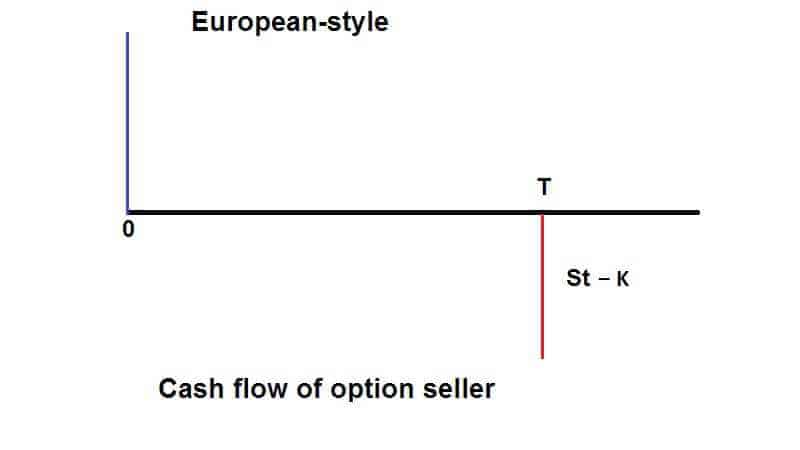
    European-style

    The seller sells the (call) option to allow the buyer to buy the underlying at the price of K on the expiration date only.

    American option pricing and early exercise

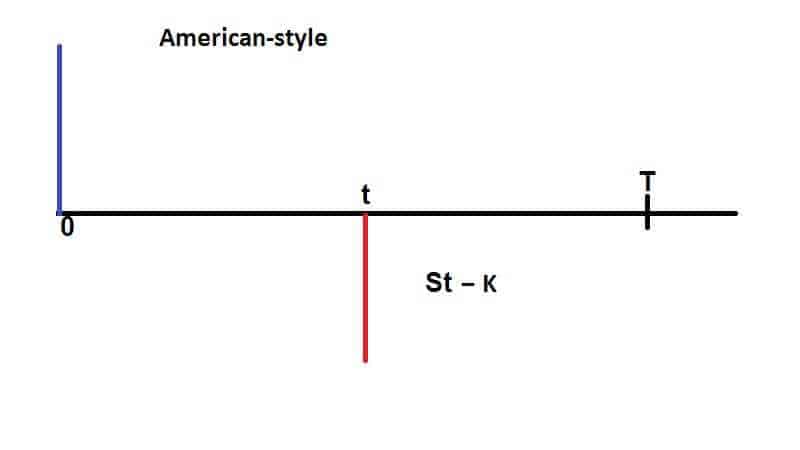
    American-style

    The seller sells the (call) option to allow the buyer to buy the underlying at the price of K and another option to buy at any time no later than the expiration date.

    American option pricing and early exercise 1

    In these graphs, you can see the main difference.

    The key difference between American and European options relates to when the options can be exercised: A European option may be exercised only at the expiration date of the option, i.e. at a single pre-defined point in time. An American option, on the other hand, may be exercised at any time before the expiration date.

    American options can be exercised early

    Unlike a European option, the holder of an American option can exercise the option before the expiry date. Because of this additional benefit, an American option is always more expensive than a European option.

    However, is this benefit of any real use? Is there a situation where the option holder will get a better payoff by exercising the option early?

    The answer is NO.

    You should never early exercise an American option, especially if it’s a non-dividend paying stock. Let’s look at the reasoning behind this.

    The option has intrinsic value and time value. The intrinsic value of the option is always greater than 0.
    Along with that, the cash has time value. So, you would rather delay paying the strike price by exercising it. As late as possible.
    You could use that money to earn interest.

    So, a positive intrinsic value plus time value implies that you are better off selling the option rather than exercising it early. This is true for a non-dividend paying stock.

    However, for a dividend paying stock, the only time it may pay to exercise a call option is the day before the stock goes ex-dividend. And only if the dividend minus the cost of carry is less than the corresponding Put.

    By exercising, the option holder may forego the time value.

    But don’t worry, it will make up from the dividend received.

    We use the word ā€˜may’ because the dividend may not be high enough to justify the early exercise.

    Here is the model for American options pricing. Here we take into account a put as an example.

    Let
    V = V (S, t)

    be the option value.

    At expiry, we still have
    V (S, T)=(X āˆ’ S) +

    The early exercise feature gives the constraint
    V (S, t) ≄ X āˆ’ S

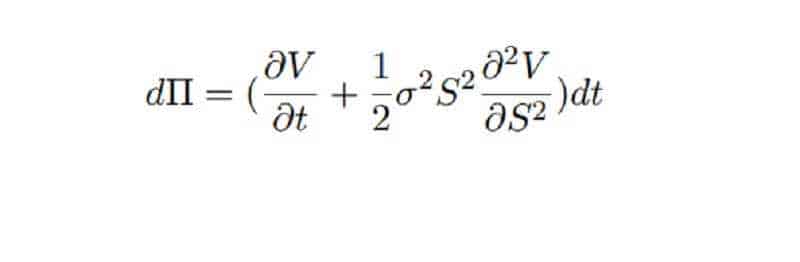
    As before, we construct a portfolio of one long American option position and a short position in some quantity āˆ†, of the underlying.

    Ī  = V āˆ’ āˆ†S
    With the choice āˆ† = āˆ‚V/āˆ‚S, the value of this portfolio changes by the amount

    American option pricing and early exercise 2

    The advantage of the American style

    The principal advantage of the American style of an option contract is the flexibility it offers to its holder as it can be exercised anytime before the expiration date T. Majority derivative contracts traded in financial markets are of the American style. In mathematical modeling of American options, unlike European style options, there is the possibility of early exercising the contract at some time t* ∈ [0, T) prior to the maturity time T.

    It is well-known that pricing an American call option on an underlying stock paying continuous dividend yield q > 0 leads to a free boundary problem. In addition to a function V (t, S), we need to find the early exercise boundary function Sf (t), t ∈ [0, T].

    The function Sf (t) has the following properties:

    If Sf (t) > S for t ∈ [0, T] then V (t, S) > (S āˆ’ E)+
    If Sf (t) ≤ S for t ∈ [0, T] then V (t, S) = (S āˆ’ E)+

    The free boundary problem for pricing an American call option consists in finding a function V (t, S) and the early exercise boundary function Sf such that V solves the Black-Scholes PDE on a time depending domain:

    {(t, S), 0 < S < Sf (t)} and V (t, Sf (t)) = Sf (t) āˆ’ E, and āˆ‚SV (t, Sf (t)) = 1

    In a stylized financial market, the price of a European style option can be computed from a solution to the well-known Black–Scholes linear parabolic equation derived by Black and Scholes.

    Recall that a European call option gives its owner the right but not the obligation to purchase an underlying asset at the expiration price E at the expiration time T.

    But, let’s makeĀ American option pricing simpler

    The value and pricing of stocks are fairly simple for most investors to understand. Basically, the value of a stock at any given time should reflect all known information about the company and the market.

    However, increased volatility in option value occurs when the expiration date draws close or when it is already “in-the-money.” A call option is “in-the-money” when the present price of the underlying stock is higher than the strike price. A put option is considered to be “in-the-money” when the market price is lower than the strike price. When options are “in-the-money” or close to their expiration date, their value will change at a different rate than the underlying stock. However, the Black Scholes formula is a mathematical equation that can be used to approximate the value of an option relative to its market price.

    Delta (Ī”) in the Black Scholes formula is equal to the amount that the value of the option is expected to move for every 1 point of movement in the price of the underlying stock. Thus, if delta is 0.5 for stock A, then the value of the option for that stock will increase or decrease by 0.5 for every 1 point of fluctuation in the stock price.

    In addition to being affected by proximity to the expiration date and being “in” or “out” of the money, the value of delta may change due to the overall volatility of the underlying stock itself.

    There are times, however, when the Black Scholes formula fails to predict the value of the option.Ā 

    The bottom line

    The overall value of an option is actually determined by six factors: strike price, the current market price of an underlying stock, dividend yield, prime interest rate, proximity to the expiration date, and the volatility of the stock prices over the course of the option.Ā 

    Because these six variables combine in different ways to affect the value of an option, it is possible for the price of the underlying stock to increase while the value of the option falls. The Black Scholes formula may fail when other factors are affecting the value of the option more than the current stock price.

    American option pricingĀ uses a “discrete-time” model of the varying price over time of the underlying financial instrument.

    risk disclosure

  • Forex Trading – Simple Tricks to Master it

    Forex Trading – Simple Tricks to Master it

    4 min read

    Forex Trading - Simple Tricks to Master it

    Forex trading could lead to high returns of investment. This article will explain how

    Forex trading – theĀ CONCEPT:

    Forex represents the foreign exchange/currency market. The word forex itself is made of two English words: foreign and exchange and signifies the purchase of currencies from different countries.

    Forex Trading - Simple Tricks to Master it

    Unlike other stock exchanges, Forex does not have its physical seat in a city. It exists in an electronic network consisting of large financial institutions.

    Also unlike other financial assets – Currency needs to be at a balance point!


    Why Forex industry has to be at a balance pointĀ (UNLIKE STOCKS for example)?

    Because let’s think about a country, like the USA. Its currency is USD and you can invest your money on USD comparing, say, Euro. So if the USD is increased (or Euro is decreased) you gain a profit.

    But inside the USA – the interests are different.

    Forex trading is an industry of importers and industry of exporters.

    Let’s say I’m an importer that lives in the USA, and I import apples from Mexico. And just for the explanation, we say that 1USD (US Dollar) = 2 MXN (Mexico’s currency).

    Now I make a deal with my fellow Mexican that I buy apples for the worth of 2 million MXN (and it costs me 1 million USD).

    Now, if the USD will get stronger, and now we say that 1 USD = 3 MXN.

    See? I’m losing money because I could have bought my goods for a lot more money at the same price I spend (1 million Dollars).

    But let’s say it’s the opposite – I’m the exporter. My fellow Mexican buy from me apples at the same original deal. This means he buys from me at 2 million MXN and I get 1 million Dollar. But then, the Dollar is rising and now it’s worth 1 USD = 3 MXN. He still buys at 2 million, right? So now those 2 million worth approx. 0.67 million USD. Now I’m LOSING money because of MY OWN currency worth more. That’s Forex. It has to have a balance point because if not we’ll have our own people losing.

    Today, Forex is the largest financial market, which has a daily turnover of around $ 5.5 trillion a day. You can complete this whole process online.

    The term currency market means the sale of one currency with the simultaneous purchase of the other.

    As currency pairs are traded, in order to profit from the shift in the exchange rate, you need to buy the currency that you think will strengthen and sell the other.

    YOU WOULD LIKE TO READ about How to Become A Trader or Investor in Just 10 Minutes

    There is no need to wait for a growing market to profit. At any moment, one currency will strengthen in relation to the other.

    The Forex market is constantly creating opportunities for investment.

    Since nothing concrete and tangible anything is bought and sold, this type of trade can be a little confusing. You should think that you are buying a part of the value of a country.

    If you buy a Japanese yen, you are buying a part of the Japanese economy that is in direct correlation with what the market thinks about the current and future health of the Japanese economy.

    Generally, the established exchange rate of the two currencies is a ratio that reflects the state of one economy in relation to the state of another economy (the state, the currency).

    What Do You Know About Forex Trading? 5

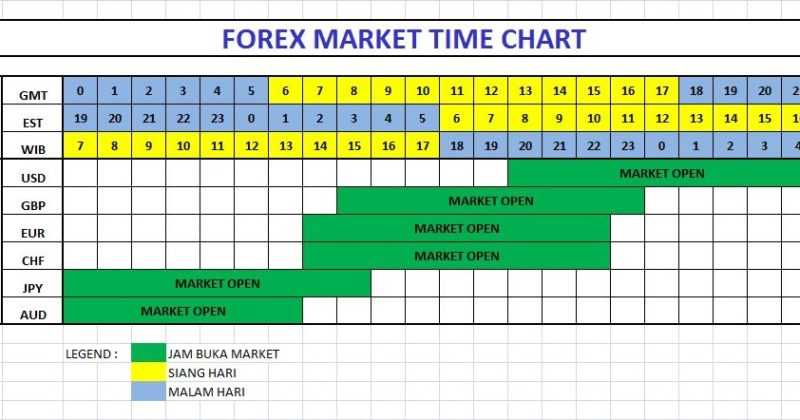
    Forex is opened 24 hours a day, except on weekends, so that Sunday trading starts on Sunday from 21:15 CET and runs until Friday at 23:00 CET. During the day there are several time intervals that coincide with the working hours of the world’s largest stock markets.

    Who trades on the FX market?

    Forex traders can be classified into two groups, hedgers and speculators.

    Hedgers: governments, companies (importers and exporters) and some investors who are exposed to exchange rate changes.

    Speculators: This group, which includes banks, funds, corporations, and individuals, creates artificial pressure on the course in order to profit from variations or price movements.

    YOU WOULD LIKE TO READ about Algo/Algorithm trading in financial markets

    Basic terms of Forex trading

    Pip – Represents a change in the ratio of the currency by one decimal. It is the smallest unit change course. Pip is the last decimal in a currency relationship

    Stop and Limit – Orders – Ā Often the trader wants to limit the loss in the position he has opened (in that case he sets the “stop” order). Or the trader wants to take profit at a certain level, which is acceptable to him/she (in this case he sets a “limit” order).

    LongUsed for the purchase order

    Short Tension used for a sales order

    BidBid price

    Ask The price that is claimed

    BuyShopping

    SellSale

    SpreadThe difference between the sale and purchase price

    Chart – Graph

    Timeframe – Time period

    Leverage – Multiplies the amount of money you invest

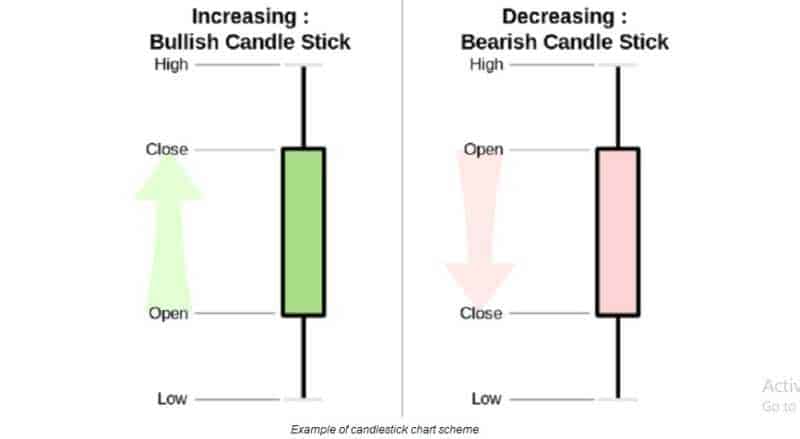
    Candlestick – Ā Candlesticks show that emotion by visually representing the size of price moves with different colors. Red means the starting price was higher than the closing price at a certain time. Green means it ended higher than the starting point.


    How to read candlestick graph: To every time period

    Open – The price of an asset at the start of a time period
    Close – The price of the same asset at the END of the same time period
    High –Ā  The highest price the asset reached during that time period
    Low –Ā  The lowest price the asset reached at the same time
    Time period – Can be from 1 minute to one year

    What is needed to trade on Forex?

    Before you start trading the currency, you need to open an account with a Forex broker. Our recommendation is that before you decide on trading on Forex, open a demo account with one of the brokers.

    You can use a trustworthy Forex broker.Ā 


    So that through the use of the platform, you will be able to monitor market activities and learn more.

    YOU WOULD LIKE TO READ about the best Forex trading styles

    Conditions for Success Forex trading

    You must have a good knowledge of technical and fundamental analysis, as well as managing your account. You should also know the psychological aspect of the trade and that you are disciplined. Also, in Forex trading, you should learn about the country you’re betting on or against.

    To be able to trade Forex successfully, there is a whole world of education, really extensive analysis. Also, the countless hours of tracking a very large number of relevant and potentially relevant information.

    YOU WOULD LIKE TO READ How To Choose The Best Forex Program

    All without any guarantee that the right decision will be made.

    So once again, the investment rule has been confirmed: high risk must be taken to achieve high income.

    Risk Disclosure (read carefully!)

    67% of retail investor accounts lose money when trading CFDs with this provider. You should consider whether
    you can afford to take the high risk of losing your money.

  • Tricks of The Trade

    Tricks of The Trade

    Tricks of The Trade
    Don’t eve try to find or use tricks in the trade, here is why.

    By Guy Avtalyon

    There are no tricks of the trade. You will find no hacks or cheat-sheets. All you can find are countless strategies to choose from depending on your trading style and many wise practices to follow.

    In short: Learn before earn. Whenever it seems something is very obvious, first see how theĀ market is behaving before making up your mind to go long or short. Start with paper trading. Learn Technical and Fundamental analysis. Access your risk ability and only take positions in which you are comfortable with possible loss.

    After many hours and a lot of coffee, we had one conclusion: There are 3 types of trade. You have to choose your strategy. If you make the right pick and learn a lot you have a chance to become a master in it.

    At first, you should get theoretical knowledge about the market.

    Educate yourself and read special books. Read blogs. You can find a good piece of advice there. Make out a trading strategy or taking an already working one (find it on the Internet), test it, and see how it works. Try to master it. But don’t go away from its rules (you can change the rules, of course).

    Practice. You need practice. Start with a demo account. All of them are free and you can get even several accounts from different brokers to compare them and find the best one for you. Then continue with trading real money, decide what strategy is yours, and start making money!

    Remember, that you should keep in mind all the tips or tricks of the trade which you will learn from literature. You will have to make all your decisions logic and automatic. After some time, when you’ll be experienced enough, you should feel the ground. Meet your losses and wins as a lesson.

    Define your goals and choose a trading style

    It is important to have some idea about where are you going. You have to have clear goals. Then check your trading method is capable to achieve these goals. Each trading style has a different risk profile. That requires a certain attitude and approach to trade successfully.


    You have to be sure your character fits the style of trading you deal with. The mismatch will lead to stress and definite losses. Learn and practice.

    It is better than trying to find tricks of the trade.

    Take this small tip regarding calculating expectancy:

    Expectancy is the formula you use to determine how reliable your system is. You should go back in time and measure all your trades that were winners versus losers. Then determine how profitable your winning trades were versus how much your losing trades lost.

    Take a look at your last 10 trades. If you haven’t made actual trades yet, go back on your chart to where your system would have indicated that you should enter and exit a trade. Determine if you would have made a profit or a loss. Write these results down. Total all your winning trades and divide the answer by the number of winning trades you made.

    Choose an appropriate trading platform

    Choosing an online broker seems like a simple process. But in reality, it can be a nightmare because finding the right broker is not easy. In the very beginning, you want to be sure that the broker has the right credentials, understands the market, has similar wealth-building beliefs as you do. The most important question is about what type of trader you want to be. Are you an active trader or buy-and-hold investor? Whatever you are, it will affect your choice of broker. If you are a buy-and-hold investor and invest in index funds, making a few trades per year, fund selection may be more important to you than low transaction fees. If you like to trade off of Fibonacci numbers, be sure the broker’s platform can draw Fibonacci lines. These are the best tricks of the trade.

    Choosing a respected broker is of main importance. Researching the differences between brokers will be very helpful. You must know each broker’s policies.

    Have a plan before executing a trade

    You don’t need a million bells and whistles to make money, just one simple tactic that works. One of the biggest problems a trader faces is bridging the gap between trade planning and execution. Getting from a strategy looking good on paper to real-world trading performance is what it’s really all about. Without question, all the planning in the world will not do you any good if you can’t execute and reap the benefits of your work. Wins and losses come in a random distribution. It is not unreasonable to sit through a series of losing trades even if you did everything according to plan. One issue to consider is that people aren’t particularly confident in what they’re doing and this can be rectified with a little guidance.


    Understanding what it is that you are trying to achieve and what constitutes reasonable results can go a long way towards settling nerves and allowing a trader to execute how they have planned to do so. Clarity of mind and consistency of approach will help you to start to realize the potential of your strategy.

    OK, there is one trick of the trade: ā€œone punch, one kick.ā€

    The idea is to accomplish the job as quickly as possible with very minimal effort. Ā Find your edge in the market, a technique that works and sticks to your plan. If you don’t have a strategy then you shouldn’t be on the battlefield. Traders who execute random orders without a plan usually lose their money. Who needs a flying roundhouse kick, when a straight stomp to the knee will incapacitate your opponent with one simple move.

    Trade quality over quantity

    One general mistake is the need to always be in a trade. Some traders get whiplash by chasing the market during choppy conditions. Advanced traders are very picky about when to pull the trigger.

    Most of the time the markets produce a 50/50 possibility for success. You want to be patient and wait for trades that have a higher probability than a coin toss. The trick of theĀ trade is to find good trade setups not treat the markets as a roulette table.

    That said, even quality trades have an element of chance, therefore you always need to have an exit strategy to manage risk.

    Traders tend to make money when the markets are inefficient unless you’re running an algorithm that scalps a flat market, stay away from choppy or stable price action. Only trade in market conditions that are conducive to your particular trading strategy.

    As we said before, there are noĀ tricks of the trade. Trading is an art. The only way to become skilled is through consistent and disciplined practice. That’s the trick of the trade.