
Category: How to Master in Trading – Advanced


The purpose of the category How to master in trading – advanced is to give experienced traders an insight into the new trading techniques. Very often they are very rarely used because they require advanced knowledge in many fields – from complex mathematical operations and calculations to the usage of high-level trading tools. Traders-Paradise’s goal is to inform about them. But not only that. The main intention is to make them familiar to all traders. No matter are they beginners or elite.

Traders-Paradise gives you an opportunity

In trading, just like it is in many fields, having advanced knowledge is an advantage per se. Thanks to our excellent analysts and experts, the most advanced techniques are available to the traders. Moreover, each of them is fully explained, with real trading examples. All complicated mathematical calculations are explained in detail. So, traders need to have on hand this valuable information and samples.

Traders-Paradise insists on quality

Concerning beginners’ already gathered knowledge, sometimes the explanation in the posts in the category How To Master Trading- Advanced will not be enough clear no matter how much we want that. Simply, to understand what our team writes here, the visitor will need to improve the skills. For them, Traders-Paradise has one simple piece of advice – visit one of our categories designed and written exclusively for the beginners.
This category – How to Master In Trading – Advanced is directed at elite traders. The impressive thing is that all posts and articles are very precise in explanation no matter how complicated the subject is. All advanced trading techniques, methods, strategies are understandable thanks to comprehensive and detailed explanations.

  • Trailing Stop Loss Definition and Examples

    Trailing Stop Loss Definition and Examples

    3 min read

    Trailing Stop Loss Definition and Examples

    The trailing stop loss may be practiced with stock, options, and futures exchanges that support regular stop-loss orders. It is a variety of stop-loss order. A trailing stop-loss order is executed when the price of the trading asset drops by the trailing value which can be expressed in percentage or currency amount. 

    For example, you might place a trailing stop order to sell your stock with a trailing stop loss of 4%. When the stock dropped 4% from its nearest high the trailing stop order will be executed.

    For example, assume that ABC stock is in its uptrend and hits $100 per share. If you placed a trailing stop loss of 4% it would be triggered when the price drops to $96 or below. Hence, your trailing stop loss at 96%, the sell order at $96 would be a market order. Instead, you can set a trailing stop limit which would provide you to gain a specified price placed in advance.

    Also, instead of placing percentages you may enter a trailing stop loss in currency. It is more favorable. Let’s do some math.

    Let’s say, ABC shares increase to $120, a $4 trailing stop would trigger at $116, which is a 3,3 % drop. If you entered a 4% trailing stop, it wouldn’t trigger until the shares fell 4% to $115.
    \

    The mistakes about using a trailing stop

    A typical mistake is to set a trailing stop too close to the current price. For example, 1% or 2% trailing stop loss. Most stock prices are changing by at least a few cents per minute. If you set the trailing stop loss too tied to the entry it will be stopped out before any significant price moves occurred. 

    The best way is to set a trailing stop distance enough from the current price. If you keep in mind that that the market regularly fluctuates inside a 10 cent span, you would like to set it a bit far from that amount. But be aware, if you set it more from that range because it could happen that you never reach the placed point. The consequence is that the trailing stop could be invalidated and never executed.

    The point of using the trailing stop loss is to get you out of the trade if there is a high possibility of the price changing and destroying your profit on your trade. 

    Trailing stops are useful because they secure in profit when the price moves in our beneficial. The disadvantage is that sometimes they get us out of a trade when the price isn’t really changing, but simply pulling back a little. A good option to a trailing stop loss is to apply a profit target, have that in your mind.

    How to move a trailing stop loss 

    It is easy to find a lot of brokers that provide this type of orders. It’s up to you to choose how much space you want to in your trade. Think twice would you like to set it in percentages or currencies (you have both examples above). When you confirm the order it will move as the market moves because that is the nature of trailing stops: to move as the prices move. You can set it automatically or manually.

    Bottom line

    Traders use different systems to improve their profits and diminish the losses. One of these methods is the trailing stop order. It allows you to define the circumstances that will trigger an order to exit your position. It safeguards your trade against unexpected downturns.

    No matter if you are trading stocks, bonds or whatever, you must have a solid exit strategy. Moreover, you must have it before you buy the position. We already wrote about emotional trading. A good exit strategy will allow you to diminish fears. Let’s say your exit strategy is to wait for the price of your stocks to drop by 15%. You’ll be able to avoid trading in a panic if your stocks drop by 10%. That is the main purpose of applying a trailing stops and other stop-loss orders, to give you a plan to realize your exit strategy.


    Don’t miss this: Trading With Success – A FULL guide for beginners

  • Negative Balance Protection

    Negative Balance Protection

    4 min read

    Negative Balance Protection

    by G. Gligorijevic

    Negative balance protection signifies that you will not lose more than your deposited money. Or to put it simply, you won’t owe money to your broker. Sounds great, indeed. You will not end up with a cash debt on your account.

    At first glance, this looks like a great thing. For example in spread betting, that lets traders take leveraged short-term bets on stocks could end in tremendous losses.

    Here is one example.

    Assume you put $10,000 to your account and want to buy stock. Let’s say the leverage is 5:1 which would provide you a position of $50,000. But, the market is really volatile those days and the price of your stock drops, for example, 8%. Remember, your leverage is 5:1, so this drop would make you a loss of 40%. It is $20,000 of lost. This lost would destroy your deposit of $10,000 and you have to pay back to your broker what you owe. Yes, this is an unpleasant situation but if you are trading with a broker who lets you negative balance protection, your loss would be exactly the amount you deposited, $10,000. Nothing more, nothing less. 

    It is a great thing for traders.

    Negative balance protection is a proposal that brokers practice in order to protect their customers. This method guarantees that traders will not lose more than their deposit is if their account moves into negative as a result of their trading activity. This is a great reason to choose the broker that provides it. You will not owe the money to your broker if you made the wrong trading choice.

    Yes, the brokers always have a margin call to protect. The truth is that this option isn’t the best choice when the market’s shift quickly and the stock prices are in high-speed movements. If the price moves too fast and moves beyond your margin call out level you may lose more than it is expected.

    Negative balance protection in Forex

    Negative Balance Protection

    It protects your account balance never to falls under zero. How is possible for your Forex trading account to go under zero?

    Don”t be worried. Your broker has protection, in the first place it is margin call. But, the same occurs as it is with stocks. When some incredible drastic move happens in the currency markets, your broker may not be able to close your trade immediately. Also, your stop-loss order will not be executed due to the high speed of the market movement.

    Therefore, the price may run beyond your stop loss or margin call close out level. That may cause a larger loss that exceeds the size of your account balance. So, you would have a negative balance.

    This is where negative balance protection comes to the scene. The broker can overlook or forgive your negative balance and lets your account to begin from zero again.

    Why traders need this?

    Forex and CFD markets are volatile. That makes traders unprotected in sudden price movements and gaps. When extreme price movements happen in open trade, this may have an important influence on the value of your open positions. It is particularly dangerous when your position is highly leveraged.

    If you hold a leveraged long position, you would lose more than your initial deposit. And as I said before, this would put you in a position where you would have to pay your debt back to your broker.

    Negative balance protection resets your account balances to zero.

    Is there anything bad?

    In short, yes.
    When you enter the market you are dealing with some unresponsible people who don’t pay attention to the risk involved because their goal is to beat the market. Sic!
    When you set negative balance protection heaven isn’t the limit. This safety net wouldn’t let you take additional risks just because you have the belief that you can make easy money. Stay in the safe zone, it is smarter and better for your trading account.
    Also, if you put negative balance protection, you have to pay increased margin rates. 

    The history of negative balance protection 

    It grew more prominent after the Swiss franc crisis in 2011. That was when the Swiss National Bank (SNB) closed holding its currency against the EUR at a fixed currency rate. The Swiss franc rapidly soared against the EUR. The consequence was that numerous traders shorting the franc ended up with enormous negative balances losing more than they had deposited on their account.
    The Swiss market had great losses and many traders ended up with the fear that their brokers would ask to get paid to cover their losses.
    The brokers that provide the leverage are obliged to apply for negative balance protection on a per-account basis, thanks to ESMA regulation for the EU.

  • Market Timing – A Way to Beat The Stock Market

    Market Timing – A Way to Beat The Stock Market

    market timing
    How is market timing possible? Read to the end.

    By Guy Avtalyon

    Market timing is the method of buying and selling in the market based on financial inclinations, business information, and market circumstances

    It is a kind of investment or trading strategy. It is an effort to beat the stock market by prognosticating its movements and buy and sell according to that data. While you are making moves in the financial market, changing the asset classes, you need some predictions. To make predictions you need tools, for example, technical indicators, financial and economic data, to be able to estimate how the market will move. 

    From these tools needed you can easily see that the market timing is in contrast to a buy-and-hold strategy.

    Some investors don’t believe that is impossible to time the market. But on the other side, you have a whole range of investors, especially traders that are sure in it. Well, both sides are right, at some point. It is pretty hard to time the market, but it is possible for the short run. Seeking to time the market over the long run can be difficult and may show a lack of consistency.

    Is market timing possible?

    If you are a short-term trader or full-time investor, you may have some good results but you have to be an exceptional one to notice the right time to buy and sell in the market. The statistic is explicit, there is no notable success in comparison with the buy-and-hold investor.

    Market timing is related to tactical asset allocation or dynamic investing.

    Let’s say you want to invest $10,000 and you put $5,000 in the stock, $3,00 in the bonds, and $2,000 in the cash. 

    The market timer tries to sell when the price is the highest and to sell when the price is at the lowest level. So, the trader or investor confidence to market time will sell some part of stocks in case the interest rates are increasing and buy bonds. Such an investor wants to profit from something called a market “peak” for stocks and the start of growth for bonds.

    The believer in market timing is sure that price movements in short-time are essential and usually predictable. That’s why the market anomalies are important to them to support their opinion. Chart patterns that are repeating are also important to them. Their investment horizon is shorter, it can be minutes, days, or months. On the other side, long-term investors, so-called buy-and-hold, prefer to estimate the long-term potential of their investments by employing fundamental analysis. They are estimating the company’s strategies, products, etc.

    Market time investors will use leverage to gain returns. This will add more risk to their portfolios but their returns could be higher too.

    Are there any costs for it?

    Investors that practice this strategy claim that by using this method they are able to diminish losses. The principle is quite simple, they just have to move one sector before drawbacks. You see, their aim is to find a safe investment and avoid market volatility while they are holding volatile investments. Market timing investors that attempt to time entries and exits very often may underperform the long-term investors. The reason behind, it is extremely hard to gauge the next direction of the market. Despite their optimism, the real costs for the majority of them are higher than the possible gain of moving in and out of the market. 

    There are also extra trading commissions and capital gains taxes. The continuous analysis linked with market timing requires frequent asset reallocation and a lot of trading activity. Much more than passive investing. If you want to practice this method you will need more time and an excellent education.

    Market timing is a questionable approach. You can find a lot of very serious studies that have revealed that the market’s bottoms and tops are pretty hard to find consistently.

    Moreover, long-term investors truly support the efficient market hypothesis, which claims that the prices are random and reflect all available data, so it is impossible to outperform the market in the long run. It is especially too hard in a short time since it is impossible to forecast stock prices. Although, market timing has huge and faithful followers among investors. Can we say they are enjoying the challenge to consistently produce higher-average returns? Maybe.

    The most important thing for all investors is the fact that they have to watch their investments, to watch charts and they have to know the market timing method.

  • Guaranteed Stop-Loss Order

    Guaranteed Stop-Loss Order

    3 min read

    Guaranteed stop-loss order

    Guaranteed stop-loss order or GSLO act precisely the same as normal stop-loss order but as difference, it ensures to close you out of a trade at the price you define no matter how the market is volatile.

    Guaranteed stop-loss order protects you against gapping. Gapping is when a price of stock opens above or below the prior close with no trading action in between. It can happen the price surges over a stop-loss level. The role of a guaranteed stop-loss order is to force order to go through at a particular price.

    The market can top higher or drop more than the guaranteed stop-loss level. So, setting this kind of order is important to protect your profit especially if your holding very liquid stocks.

    Particularly, using a guaranteed stop-loss order in the spread betting is extremely important.

    The guaranteed stop-loss order, for instance, when used properly and in the right situations, is a right risk control tool since it guarantees the stop loss level. You can even rise the guaranteed stop-loss level up if the trade is going your direction. Also, it allows the stock to come back a little to provide profits run.

    When guaranteed stop-loss order should be set?

    The guaranteed stop-loss order is useful if you are trading in extremely hight volatile conditions, or you are trading in risky exchanges, for example. Actually, you should set a guaranteed stop-loss order every time you have some doubts about the risk.

    A guaranteed stop-loss order will close your position at the stop price no matter what happens in the market.

    Advantages of guaranteed stop-loss

    As I said, it is useful when the markets are highly volatile and market gaps. Also, it is great protection against price dropping. If you set this order, the only risk you would have might be your initial investment. Moreover, the advantage of this order is that you have the possibility to know what is the maximum risk for any position. Also, you don’t have to control your position all the time.

    How does it really work?

    When you set a guaranteed stop-loss order there is no possibility to undo it but you may change the level. 

    You can’t add this order to the existing position, you can do it only on the new one during the trading hours. 

    You have to pay extra fees to broke for setting this order but it is worth. A guaranteed stop order must be placed inside distances of minimum and maximum from the current price of the stock.

    Let’s say the ABC company buy/sell rates are $1,000 and $980. And assume you are buying 10 shares. The spread is $20. And, for example, you set the guaranteed stop-loss order at $920. The price of these shares may drop at $800 but your position would be closed at $920, not at $800.

    Let’s calculate your loss with using GSLO

    ($920 – $1.000) x 10 – $20 = your loss is $820 

    and what is your loss without setting GSLO?

    ($800 – $ 1.000) x 10 = your loss would be $2.000

    Can you see the importance of setting a guaranteed stop-loss order?

    A normal stop-loss order serves as a guide to your broker to close your position when it hits a established price that is less desirable than the current price. But if there is a market gap or the market is highly volatile, the slippage will occur. The consequence is that your order will not be executed at the price you specified. By setting the GSLO you are protected from market gaps and volatility. They will not impact your trading position. As you can see, this kind of orders works in the same manner as normal stop-loss orders but with more protection for your trade and your money.

    These orders are useful and recommended if you trade high volatile stocks, for example. Everywhere where the value may drop for 50% off the price, it is useful. 

    But, be aware, it isn’t a silver bullet in the spread betting. 

    The brokers usually allow you to set guaranteed stop-loss order 5 to 10% off the current price. This means that you may have a potential loss of 10% before your GSLO is activated. In such cases don’t set GSLO only 5% away from the market. It is too dangerous if you have a margin of 10% for trade. Also, even when the spread betting provider requires only 5% for trading your stock, there is always a margin call. 

    So, it doesn’t sound like the best money management.

  • Spread Betting With Examples

    Spread Betting With Examples

    3 min read

    Spread Betting With Examples

    Let’s be frank.

    Spread betting is extremely risky. It’s highly dangerous. It’s not for beginners and people with lack of knowledge. 

    But to be totally honest, it is one of the simplest ways for an individual investor to support their ideas with hard cash. If you treat the market proper, you can get big gains, very fast.

    What is spread betting and how it works?

    Spread betting simply lets you guessing will the price of some stock climb or drop. You can speculate from stocks to house values.

    Moreover, you don’t need to purchase the stock you want to trade. You just take a look at the prices submitted by the spread betting provider and speculate if the price will increase or decrease.

    Spread betting brokerages give you a quote. The quote contains a bid price and an offer price which is a bit higher. Let’s see how it works on this example.

    Your brokerage quoted some stock price at $5,000 and a spread betting provider will give you a bid price of $4,990, for example, and an offer price of, let’s say $5,010.

    If you think the price will increase you can “buy” for $10 per point at $5,010. Every time the point is rising up you will earn $10. Say the price increased to $5,030. It is reasonable to close up the bet. 

    It is time to calculate your profit

    5030 – 5010 = 20

    20 x 10 = 200

    So, your profit is $200.

    This is in case you believe the market will grow, but if you think the market will drop, you can sell your stock at $4,990.

    But you have to know that the risk is involved here. You can indeed make a lot of money with betting on small amounts but you may lose a lot too.

    Let’s assume that you sell your stock for $10 per point at $4,990.

    How big your loss will be if the price increase to a spread at 4,990/5,020?

    Let’s calculate this.

    4990 – 5030 = 40

    20 x $10 = $400

    Your loss is $400.

    You see, you can make huge losses if your trade goes in the wrong direction. And this isn’t the only loss you may gain. Spread betting brokers will demand you to pay margin. Usually, it is about 10% but can be less or more. 

    The dangerous situation can arise if your losses on the trade approach near to the margin. In such a case, the broker may require more money from you and activate a margin call. What will happen if you can not come with that? The spread betting provider may close and will do, your position at a current price.

    You don’t want a margin call to control your losses or you’ll be broke. Instead, set stop-loss order to close your trade at a particular price.

    Let’s use our example again.

    For example, you sold stock at $4,990 but you placed a stop loss at an offer price of $5,010, how big your loss would be?

    4990 – 5010 = -20 

    -20 x $10 = loss $200

    Your loss would be $200 which is pretty much less than $400. 

    But there is a problem with markets moving. What if it is too fast? It is gapping. A normal stop-loss order will not prevent your trade since a lot of stop-loss orders are triggered together. That will cause the trades to be closed at the market price closest to the defined price and it usually isn’t the level you wanted or expected.

    The better choice is to set a guaranteed stop. This will cost you more since your broker will ask more money to get you out at a settled price. In this case, it isn’t in the question how many other stop-loss orders are activated beside yours. Actually, your broker will buy you out of the trade. This is very important when the market is highly volatile and you would like to pay a bit more to stay in a safe zone.

    But there must be advantages also

    One end is the tax break. In many countries (we are sure for the UK), you will not pay taxes on profits gained in spread betting or on capital gains from it. The other reason is that you don’t need to pay a fee to your broker when spread betting. Your broker will earn money from the difference between the bid and offer price.

    But spread betting isn’t all about money. It is all about the opportunity to speculate on a full spectrum of markets. Even if you don’t have regular access to them. As it is said in the beginning, you can bet on almost everything. Currency pairs, stocks, commodities, whatever.

  • Taking A Position While Investing

    Taking A Position While Investing

    3 min read

    Taking A Position While Investing
    What is the definition of taking a position? How to accurately control your portfolio positions?

    By Gorica Gligorijevic

    Taking a position in the stock market indicates that a trader is ready to make choices, to go long or short. These are two positions that an investor can take. Going long means to buy, short to sale.
    When you hold a long position that means you own the stock. Why is this important? I like to say investing is a marathon.
    Investing takes time to grow. It requires a relatively moderate risk and moderate returns in the short run. But investing may produce bigger returns by placing both, interests and dividends to hold for a longer period of time. So, we are taking a long position when investing.
    You would like to hold your stock for several years and have a decent return. In most circumstances, you should take the profit when a stock grows 20% to 25% of the buy price.
    A “short” position relates to the sale of a stock you really don’t own. You have to borrow shares from a stockbroker. You will have the open position of shares and that has to be closed after some time. Investors who sell short believe the price of the stock will go down. And they are selling, meaning they go short.  After you go short, the price of the same stock may go down more and you can buy it back and make a profit. Never wait to the price of that stock to increase and then buy, you will catch the loss.

    If the stock’s price fell to $0, you owe the stockbroker zero and your profit would 100%. What if the stock price grows doubles when you close the position? Calculate! You may gain loss to 200%, double more of your buying price.

    But keep one thing in your minds, short selling isn’t for beginners.

    Taking a position in the investment

    You are facing the horror: that stock you bought go lower, from hour to hour, day after day.

    If it fails 5%, you may say the market is changeable, so why to be worried. But the dropping is continuing. Your stock is 10% down, after a few days 25%. To defeat a 50% loss you will actually need a 100% gain.

    How do you feel now? What are you going to do? To wait until it drops 50%?

    So, what to do?

    When to get out in the investment?

    There are several possible scenarios on taking a position but at first, try not to get panicked.

    You should get out in your investment when your stock no longer meets your goal. Or you purchased it by mistake, it can happen.

    The other reason for selling a stock can be you need money, or you would like to get out your investment because of asset allocation or reallocation.

    The general rule of investing is never getting out of your investment just because the stock price is dropping. The rule “buy high and sell low” isn’t relevant while investing. Otherwise, you will never earn money in the stock market.

    A selling an investment too quickly can hurt your portfolio.

    Can you “ensure” some positions?

    All beginners, no matter how smart they are, have illusions, so they have losses. You have to keep your losses small, don’t let them scare you and survive.

    The rules for managing the risk that we’ll show you may feel disturbing for beginners because they have small accounts. Well, the proper risk control may limits trade size. I know that. But it is important for you to know that it is a protection in the first place.

    The crucial rule of risk control is the 2% rule: never risk more than 2% of your account investment on any opened trade.

    Start by writing down three numbers for every trade: your entry, target and stop. Without them, a trade may become a gamble.

    I want to share with you one of the best advice I got when I become an investor.

    If you see your stock rises by 40% you should sell 20% of your position. When the stock later increases 49% more, sell the other 20%. That will provide you to have 125% of your primary position.

    You have 100% of the initial position. And it grows 40%:

    100%*1.4=140%

    You sell 20% of it, which means that now in your hands you have 80% left:

    140%*0.8=112%

    Stocks rise for another 40% progressively:

    112%*1.4=156.8%

    Now you sell 20% of the stock you have in your hands:

    156.8%*0.8=125.44%

    You end up with a 125.44% value of the initial position.

    To make this simpler, when you buy some stock you have 100% in your hands. After some time they rise by 40%, so you have 140% of the value. And you sell 20% of that 140% and you have 80% of that 140% in your hands which is 112%.
    After some time that 112% rise for another 40% – that means you have 156,8% in your hands. And you make another selling of 20% from that 156,8% which means you will have, after second selling, 125,44% of your initial position.
    Also, you may apply a 20% stop loss on all positions. This serves to block whipsawed. If you are properly handling your portfolio positions you could reduce lower-performing positions before the 20% level is scored.
    Taking a position in trading and investing is always in the question, so you must know how to handle your portfolio. On some assets, you are taking a long position but on others, you are taking a short position. It is necessary because you would like to protect your investments as a whole.

  • October Effect – Investing When The Stock Market Go Lower

    October Effect – Investing When The Stock Market Go Lower

    October Effect - Investing When The Stock Market Go Lower
    Is October effect just a myth or there is something?

    By Guy Avtalyon

    The October effect is a recognized market oddity when stocks tend to fail during October. The October effect is an irrational suspicion of some investors related to previous market crashes that happened during October. Investors become superstitious, you might think. Well, the fact is that some great historical market crashes happened this month.

    We will point some of them. In 1907, the Panic, later, in 1929, were three large crashes – Black Tuesday, Black Thursday and  Black Monday, after almost 60 years 1987, Black Monday happened October 19, when the Dow fell 22.6% in one day. Also, on Oct. 9, 2002, the market caught a five-year low. And the market plummeted 16% in October of 2008 when the Great Recession began.


    When the stock market crashed in 1929, the investors were surprised. It was quite unusual because only a few weeks before the stock market was on the highest level ever, the stock prices were 25% higher than in the year before. In October 1929 stocks dropped nearly 25% for only two days. It cost investors billions of dollars. This market crash led to the Great Depression. October has accepted as a permanent warning to investors of how suddenly wealth can turn over.

    What is October Effect?

    There’s no proof that this great market crashes occurred in October for any other cause. Coincidence is truly a master of the game. Since there were not too many market crashes in October, we are free to say that investors will make money during October more often than they will lose.

    According to research conducted by Yardeni Research, the medium monthly return in October 2015, was 0.4%. 

    It wasn’t a great return but still, it was. But can we say the chain of unfortunate market events over October is broken?

    The truth is that if markets go down over October, they do it very hard and painful. But just for a sec try to be reasonable. Compare the drop of 4.7% in one month with 11 good months when the average gain was about 4.1%. Everything is math.


    So, we can say, at least, that October could turn high in any direction.

    For investors, September is statistically the worst month since they lose approx 1% during this month. History shows that September can be difficult for stocks. Since 1950, it has been the most critical month for the S&P 500, with declined at an average of 0.5%. But, for the last 10 years, the S&P 500 has a 0.9% profit in September.

    Is it possible to predict the stock market?

    It is hard to predict the stock market. Markets are going up and down. You can be sure of one thing: when it is down, it will climb up. The markets go up over time and you are a long-term investor you shouldn’t be worried about the market’s condition over one month. But if you are a short-term investor your portfolio should be built mostly on cash and bonds, less on stocks. That means it is better to be a conservative investor. So, the October effect will have no or less influence on your investments.

    Investors’ sentiments can become negative when October is near. That may influence the stock market play. As investors’ feelings incline to the depressed, negative market growth can produce overreactions. They will start to sell stocks in panic and the negative influence will increase more. 

    Keep in your mind, statistically October isn’t the worst month, it is September. But due to the great market crashes that occurred over October, we have that scary phrase – October Effect.

    By the way, do you know which month is the best for the stock market? July! Remember this.
    It would be amazing if the market crashes chose to happen just in one particular month of the year. Honestly, it is impossible, like the impossible is to have just one incredible good market month.

    October is just one of the 12 months of the year. The difference from others is that leaves start to fall. That is the October effect.

  • Take Profit Order – Limit Your Risk

    Take Profit Order – Limit Your Risk

    3 min read

    Take Profit Order

    Take Profit order or shorter TP is extremely essential element in all tradings. How to place the Take profit order? The question of how to place stop-loss order is one and those two are related and connected.
    So we have to make some distinctions.

    Stop-loss order linked to the risk when you take a position.

    Take profit is related to the gain for your open position.

    Both of these elements form what we call – money management. We told you about Stop-Loss in the prior posts. In case you missed it, you can read it HERE or HERE.

    But let’s stay awhile with the definition of “Take Profit” order.

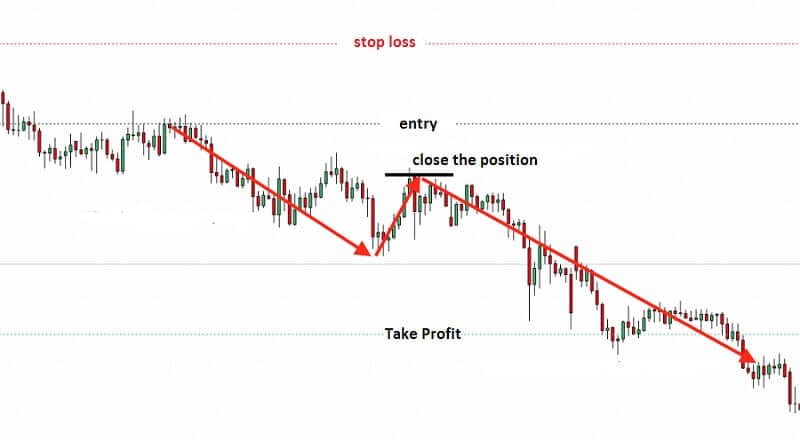
    Take Profit order is a limit order. Traders use it to close a position when the market touches a specific price level. To be more clear. Take profit represents the reward that a trader planned before taking a position. Take Profit order has to follow, must go in the same direction as the market. The trader is free to define the level of reward depending on his/her feeling of how much risk is taken to obtain adequate profit.

    Take Profit order is similar to Stop Loss order, meaning, it is an exit order. Yet,  Stop Loss order will limit your loss on a trade, but Take Profit means a price at which a successful trade will be automatically closed. To make this simpler – Take Profit is your profit target. That is the reason why you always have to set Take Profit order at the level you are expecting the price will catch. When you buy, for example, a stock, your Take Profit order must be higher than the current price. But if you are selling a stock, your Take Profit order should be below the current price.

    Yes, we know you have an excellent idea. 

    But do you know how to place a Take Profit order? 

    If you do it wrong, you will not make a sufficient profit.

    Levels of resistance and support will help you to place a proper TP. This strategy is the most successful and we will show you why.

    Take Profit Order

    First, locate a resistance level in your chart. Then place a Take Profit order a bit below the resistance. In this way, when you place TP under the resistance level, you will increase your chances to match the level that the price will hit. The next step is simple, just close your position and make a profit. This profit will always be higher.

    This is in case you notice an upward trend. But if you notice a downward trend, you have to determine a support level.

    In that case, TP has to be a bit over the support.

    Contrary to the situation with resistance, a TP level should be a bit over the support.

    Experienced traders have some TP tips. One of them is that the TP must be 2 or 3 times of the SL value. But this advice is doubtful. You have to consider more indicators, not just one. If you are trading Forex, this strategy will work for you.

    But if you are trading stocks some other rules are more convenient.

    You will make the most gains in the 20%-25% range.

    If you see a notable increase of 20% to 25% – sell.

    Why this 20%-25% range?

    Stocks tend to rise 20% to 25% after breaking out the support, then fail and set up new support. Sometimes this game resumes their progress.

    In Traders-Paradise’s Full Trading & Investing Course – Secrets Revealed

    (don’t forget to subscribe while it is free of charge, the time is limited) you find a fantastic lesson about the rules and among them an explanation of the Rule of 72.

    Following Rule 72 you can easily calculate why the 20% to 25% is adequate Profit take range.

    How to calculate?

    Divide 72 by the percentage gain you have in stock. The result will show you how many times you have to compound that gain to double your capital. Let’s say you get 3. Re-invest your capital plus gains 3 times. You will double your money easier than to make 100% profit from one stock. The net profit will be greater. But as we mentioned, you have this all and detailed explained in Traders-Paradise’s Full Trading & Investing Course – Secrets Revealed

    Why place a Profit Target?

    Determining where to exit before trade begins allows you to calculate the risk/reward ratio.

    The stop-loss defines the possible loss on a trade. But the profit target defines the possible profit. Logically, the possible reward should exceed the risk. 

    By trading with a profit target, it is possible to estimate whether a trade is worth taking. If the profit potential doesn’t exceed the risk, don’t take a trade. By establishing a profit target you can eliminate weak trades.

  • Short Selling For Profit

    Short Selling For Profit

    Short Selling For The Profit
    What to do with stocks when the price starts to decline? Bet that a stock will fall more.

    By Guy Avtalyon

    Short selling for profit is a trading strategy that attempts to profit from an expected decrease in the price of a security. Basically, a short-seller wants to sell at a higher price and buy at lower.

    How does short selling for profit work? 

    Let’s you are a trader and you have some information that some stock will decrease in value by the expiration date. Ofc, you don’t hold that stock but you can borrow it from a broker. For example, you borrow 100 stocks at $10 market price. And you open the position, meaning you want to sell them at market price by their expiration date. And you succeed. Then you close your short position and sell your borrowed stocks for $1,000. But before you give back that 100 stocks to your broker you are betting that their price will decrease in value before the expiration day. That happens. Now, you are buying these stocks at a lower price, it is called covering the short position. 

    Let’s say, the price of your borrowed stocks declines at $6 each. 

    You sold them at $1,000, bought them at $600. Return 100 stocks to the broker and you pocket $400.

    (100x$10) – (100x$6) = $400

    The risk in this kind of trading is literally unlimited because the price may rise and rise to infinity. 

    But, the profit can be huge, also. The previous example showed a short-selling for profit. Well, by using short selling you may gain loss too.

    Example of making loss while using short selling.

    The vice versa case is when stock price increase in value during the time while you are holding them.

    Let’s say their market price rose at $14 each and you are holding 1oo stocks. The equitation will be

    $1,000 – $1,400 = – $400

    You borrowed those stocks at a $10 market price. But despite your expectations, the price increased which means you made a wrong bet. But you have an obligation to return those to the broker, hence you have to buy them back at that higher price. In this transaction, your loss is $400.

    Short selling for profit is a method for traders to benefit from a drop in a stock’s price.

    Short selling is only possible by borrowing stocks. The problem is they are not always available because when they are you may be faced with a crowd of other traders that already massively trade them. 

    Is short selling for profit risky?

    The short-selling for profit can be risky and questionable. When a huge number of traders choose to short some stocks, their actions will make a great influence on the stock price. With such big traders’ interest, the price will decline sharply. That is not a good situation for companies. Their market value decreases. Sometimes the markets forbid short-selling, especially during the economic crisis.

    As I said, short selling is risky for plenty of reasons. You can make a great loss if the stock price increases instead to decrease.

    The other reason is that the sharp increase in selected stock may cause traders to cover the position all at once. Moreover, short-covering usually force the price to go up. Then you have a situation that more and more short-sellers are covering their positions and such stock is grasped in a so-called short squeeze. So, like a chain of unfortunate events, right?

    The main purpose of short selling for profit is when you borrow the stocks from the broker to sell them instantly and buy them back at a lower price. And return them to the broker. When the whole process is finished you should profit from the difference in stock price.

    Risks of short selling

    Short selling involves a magnified risk. When you buy a stock you can lose only the money that you have invested. For example, if you bought one share at $300, the maximum you could lose is $300. Stocks can fall to $0 and that is the maximum, there is no stock that may fall below zero. The maximum in your potential loss will stop at your initial capital invested.
    In short selling, you can potentially lose an infinite amount of money. Stock can increase its value for an infinite time to an inconstant price. So, you’ll have an infinite loss.
    For example, let’s say you enter a short-selling at $200, and suddenly the stock price increases by 300% to $800. You’re obliged to buy the stock back and return them at $800, essentially losing 400% of your capital. actually, you are in incredible debt.

    Just be careful when you bet against stock price.

  • Gordon Growth Model – Mathematics of Trading

    Gordon Growth Model – Mathematics of Trading

    5 min read

    Gordon Growth Model

    by Gorica Gligorijevic

    The Gordon Growth Model is useful to determine the intrinsic value of a stock and you will see how. It is all math.
    Anyone who wants to be a profitable trader has to know math. Profitable trading is not about feelings, or prophecy and stock advice or picks. It is all about math. Yes, the main goal is to earn money more than lose.

    But trading guessing is not a good idea. The math generates success and luck in your trading. Do you want to know how the math works in your attempts to profit and be a successful trader?

    If you want to act like a pro you have to be able to explain and make the math behind your trading. Anyway, you might benefit from understanding the math behind the stock market.

    At least, you have to know the basic calculations. 

    Traders-paradise wants to show you some simple to understand. It will help you to pick the right stock and keep your hopes of future returns more realistic.

    Let’s first determine the intrinsic value of stocks. How to do that? Just use of the Gordon Growth Model. Oh, yes. You will need more explanation.

    The Gordon Growth Model is known as the dividend discount model or DDM but without the current market stipulations, meaning the factors that influence the market, such as competitors, business challenges, etc.

    The point of this Gordon Growth model is to relate the current intrinsic value of stocks to the value of a stock’s future dividends. This is a very old model but still actual and popular. The equation shows that the long-term real return from the market should be almost equal to the inflation, modified by the compound yearly growth rate in dividends and increased by the current dividend yield. 

    Let’s view this complex definition in a simple example.

    The S&P 500 real growth rate in dividends has been around 1.3% per year over almost a hundred years. At the same period, the dividend yield was 5% annual. What you have to do is to sum these both. The sum you get is a bit less than actual 6,5% compound annual return from stocks for that period.

    This is defined by an almost doubling of the PE ratio, called a speculative return. That was exactly what did add the stock returns.

    Let’s see Gordon Growth Model and how to calculate it.

    As we said the value of a stock is shown as 

    Stock’s value = D1 / (k – g)

    where D1 represents the expected annual dividend per share for the next year k is the investor’s discount rate of return. You can estimate this using the Capital Asset Pricing Model, for example.

    and g is the anticipated dividend growth rate. We take this as a constant.

    When you have all these parameters, it is so easy to calculate the intrinsic value of the stock. For example, the S&P 500 dividend yield is about 2 %, 4.5% is how much you can expect dividends to grow due to the historical performances. So you can expect a long-run return at 6.5%.

    To show you how this model is true whether or not a company pays a dividend or reinvests it let’s show you this real example.

    Suppose your preferred company plans to pay a $2 dividend per share next year (D1). Also, you expect an increase of 10% per year following (g). Also, suppose you are expecting a rate of return on the stock to be 20% (k). Let’s say, the stock is trading at $20 per share now. Using the Gordon Growth formula, you can determine that the intrinsic value of one share of the stock is:

    $2.00/(0.20-0.10) = $20

    When you have all these parameters, it is so easy to calculate the intrinsic value of the stock. 

    You will very often find the Gordon Growth Model formula calculated:

    P = D1/(r-g)

    The stock price (P) is equal to the anticipated value of the dividend (D1) divided by the difference in the investor’s rate of return (r) minus the constant growth rate of the dividend (g).

    In essence, the Dividend Growth Model utilizes the investor’s required RoR and the dividend growth rate to calculate the value of the stock. 

    But dividends will increase at different percentages. For example, dividends will grow quickly and then reach a steady rate. The dividend is still supposed to be $2 per share next year, but dividends will progress yearly by 14%, then 20%, then 24%, and then stable rise by 10%.

    By using components of this formula, but examining every year the recent dividend growth individually, we can determine the current value of the stock.

    Following the inputs for our example Gordon Growth Model formula shows:

    D1 = $2.00
    k = 10%
    g1 (dividend growth rate, first year ) = 14%
    g2 (dividend growth rate, second year) = 20%
    g3 (dividend growth rate, third year) = 24%
    gn (dividend growth rate every year after) = 10%

    Let’s calculate the fair dividends for those years (we already find the dividend growth rate):

    D1 = $2.00
    D2 = $2.00 * 1,14= $2,28
    D3 = $2,28 * 1,20 = $2,74
    D4 = $2,74 * 1,24 = $3,40 

    The next step is to calculate the current value of every single dividend during the extraordinary growth period:

    $2,00 / (1,20) = $1.67
    $2,28 / (1,20)^2 = $1.58
    $2,74 / (1,20)^3 = $1.59
    $3,40 / (1,20)^4 = $1.64

    Now we can calculate the dividend in the year of stable growth of 10%:

    D5 = $3.40 * 1.10 = $3.74 

    Further, we can use the Gordon Growth Model’s formula to calculate the value of dividends in the 5th year:

    $3.74/(0.2-0.1) = $37.40

    This allows us to calculate the present value of the dividend’s growth in this 5th year, or how much that future growth is worth to us today:

    $37.40/(1.10)^5 = $23.22

    The final step is to calculate the current intrinsic value of stocks by summing up the present value of dividends in the first four years and the value of dividends in the fifth year.

    1.67+1.58+1.59+1.64+23.22=$29.7

    The main benefit of this formula is that it may cool down your emotions when trading. Calculating this can bring you down to the ground in growth periods, and also can support you when the market is falling.

    So, can the Gordon Growth Model’s formula predict the future market returns? In short, yes. 

    But the weakness of the Gordon growth model is its hypothesis that there will be a constant growth in dividends which is rare. So, you can use this formula for companies with stable growth rates.