

Category: Traders’ Secrets


Traders’ Secrets is something that everyone would like to know, right?
How is it possible that some traders are successful all the time while others fail to make a profit all the time?
That is exactly what Traders’ Secrets will show you.
Traders-Paradise’s team reveal all trading and investing secrets to you, our visitors.

What will you find here?

How to find, buy, trade stocks, currencies, cryptos. You’ll find here what are the best strategies you can use, all with full explanation and examples.
Traders-Paradise gives you, our readers, this unique chance to uncover and fully understand everything and anything about trading and investing. The material presented here is originated from the experience of many executed trades, many mistakes made by traders and investors but written on the way that teaches you how to avoid these mistakes.

Moreover, here you’ll find some rare techniques and strategies that are successful forever, for any market condition. Also, how to trade with a little money and gain consistent returns. By following these posts you’ll e able to trade with greater success. You’ll increase your profits and your wealth, of course.

The main secret of Traders’ Secrets is that there shouldn’t be any secret for traders and investors. Rise up your trade by reading these posts, articles, and analyses!

You’ll enjoy every word written here. Moreover, after all, your trading and investing knowledge will be more extensive and effective.

Traders’ Secrets will arm you with those skills, so you’ll never have a losing trade again.

  • The quick ratio or acid test ratio

    The quick ratio or acid test ratio

    3 min read

    The quick ratio or acid test ratio 3

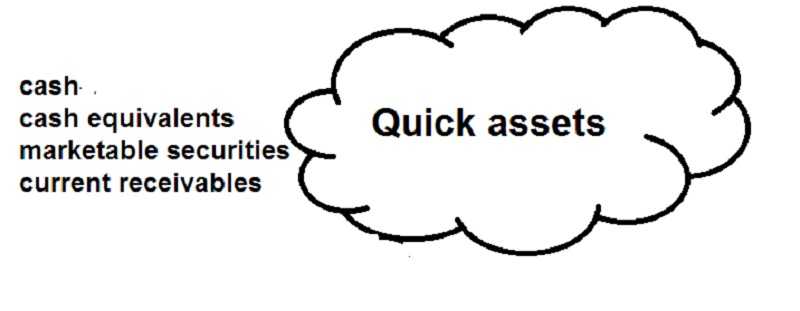
    The quick ratio is a liquidity ratio that estimates the strength of a company to pay its current obligations when they come due with only quick assets. It is also called an acid test ratio.

    Quick assets are current assets that you can change to currencies within 90 days or in the short-term.

    In other words, the quick ratio is a measure of how well a company can meet its short-term financial liabilities.
    It is liquidity metric and can be calculated as follows:

    (Cash + Marketable Securities + Accounts Receivable) / Current Liabilities

    The quick ratio can be calculated for quick assets only.
    The quick ratio or acid test ratio

    Let’s explain why sometimes the quick ratio is known as an acid ratio?

    That comes due to the historical use of acid to examine metals for gold. The early miners used it.

    If the metal passes the test, they know it is pure gold. But if the result was opposite and metal was rusting, the gold miners knew there is no value.

    The acid test of investment determines is a company able to instantly change its assets into cash within 90 days.
    So, the acid test ratio is a more traditional variant. The other liquidity metric is a modern one – the current ratio.  

    They are pretty similar but the acid test ratio gives a more precise estimation.

    How is that?

    The acid test includes only the most liquid assets to study.

    It will never examine inventory because it is almost impossible to change inventory into the cash in a short time frame. The company often sell inventory on credit.

    Yes, there are some analysts that add inventory in the ratio, but if it is more liquid than some receivables.
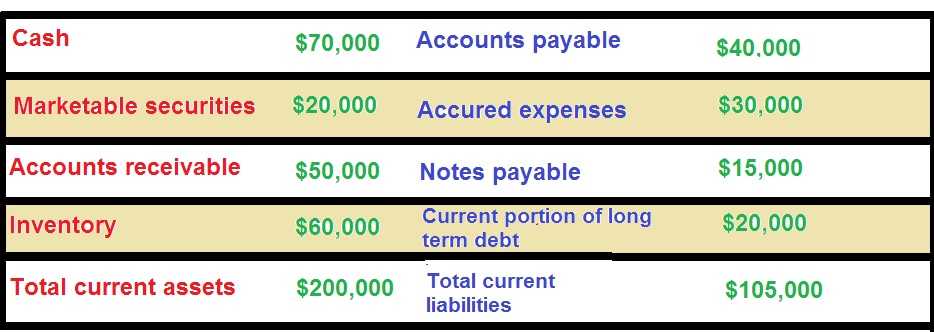
    To show you, let’s assume this information was in the balance sheet of our hypothetical firm:
    The quick ratio or acid test ratio 1

    Let’s apply the first quick ratio formula and the data above. So, we can figure this company acid test ratio:

    ($70,000+$20,000+$50,000) / $105,000 = 1,33

    This means that for every dollar of this company’s current liabilities, it has $1.33 of very liquid assets to satisfy urgent obligations.

    We will not take inventory into consideration. As we said, the company may require months or years to sell inventory.
    Why it matters?

    It is important that a company have sufficient cash to pay accounts, interests when they come to be paid. The higher ratio shows that the company is more financially secure in the short term. The companies with a quick ratio greater than 1.0 are enough capable to meet their short-term obligations.

    Low or decreasing acid- test ratios usually shows that a company is fighting to keep or increase sales.

    Maybe it is paying bills immediately or getting receivables too slowly. Hence, a high or increasing acid-test ratio means that a company has solid growth.

    It is quickly turning receivables into cash and regularly covers its financial obligations. Such a company regularly has active inventory turnover and cash exchange periods.

    However, the acid-test ratio has its possible disadvantages.

    To begin, it provides no data about the level and timing of cash flows. And it is very important because it really defines a company’s ability to pay liabilities to the arranged date.

    Also, the formula assumes that a company would sell its current assets to pay current obligations. That is not always pragmatic.

    But this analysis can give you a solid and quick view of some company’s financial status.

    It is crucial for investors to know if some company are ready to pay its bills and credits.

    Some firms use their long-term assets to produce earnings. But, selling off resources will damage the company. Also, it is a signal to investors that current plans aren’t making enough profits.

    Higher quick ratios are more welcome for the company.

    It confirms there are more quick assets than current liabilities.

    A company with a quick ratio of 1 indicates that quick assets are equal to current assets. This also shows that the company could pay off its current debts and not to sell any long-term assets.

    An acid ratio of 2 indicates that the company has twice more quick assets than current liabilities.

    And you can see how does it work. When the ratio increases, the liquidity of the company increases too.

    This is a good sign for investors. Well, this is an even better sign for creditors. You know, creditors want to know they will be paid back on time.

    One example more.

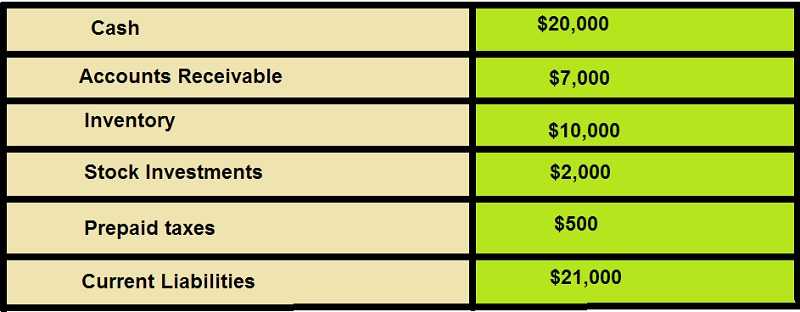
    Let’s assume some company is asking for a loan. The bank asks a complete balance sheet so it can calculate the quick ratio. Company’s balance sheet carries the following accounts:
    table

    The bank can count quick ratio like this.

    ($20,000+$7,000+$2,000) / $21,000 = 1,38

    As you can see the company’s quick ratio is 1.38. This means that the company can pay off all of the current contracts with quick assets. And moreover,  it will have some quick assets left over.

    For investors, it’s good news, too.

    Don’t waste your money!
    risk disclosure

  • Top Stocks to Buy And Hold Forever

    Top Stocks to Buy And Hold Forever

    4 min read

    Top Stocks to buy 2019 and Hold Forever
    So many people asked us what are the top stocks to buy in 2019.

    It is on a daily base.

    So, we will try to answer. This to all of you want to know and don’t have time to evaluate them.
    We don’t want your one-time appearance here, we would like to build a real relationship and confidence.

    This the article for you who want to enter the stock market this year.

    Well, you know, Warren Buffett’s personal holding season is “forever” and look how is he.

    Having that on our minds, here’s a summary of 5 stocks to buy and hold forever.

    We understand, investing is difficult. Developing a portfolio of top stocks to buy is tricky even for economic experts.

    There are still stocks to buy, don’t be worried. Moreover, they can give you really nice returns.

    • Johnson & Johnson (JNJ)

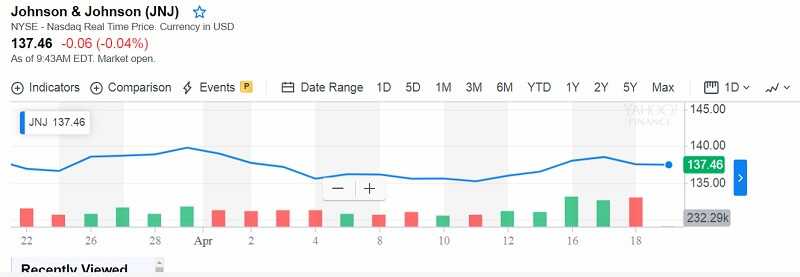
    Top Stocks to buy 2019 and Hold Forever 1Image Johnson & Johnson (JNJ) chart: source Yahoo Finance

    Everyone needs their products. They will forever have something to sell,  to us or the rest of the world. So why we, while buying their product, wouldn’t have an income?

    List of Johnson & Johnson brands is so long.

    J&J is a company with a long history.  All can identify their best brands. For example, Johnson’s Baby Shampoo or Baby Powder.

    It is founded the 1800s in New Jersey and since then Johnson & Johnson has extended its brands. Today,  you can find Johnson & Johnson brands all over the world. From your bathrooms to your doctor cabinet.

    The medicines, surgical products or healthcare solutions will never disappear. J&J has a really big portfolio.

    No one should think even a second when it comes to investing in such a company. They have products, for example, cancer drugs that will produce good growth now and in the future.

    The company is investing the robotic surgical opportunities gravely, in February announced that it’s buying robotic surgery firm Auris Health for $3.4 billion.

    J&J annual yield on the dividend is 2.60% and has an 8.46% gain per year.

    It is really among top stocks.

    • Boeing Company (BA)

    Top Stocks to buy 2019 and Hold Forever 2

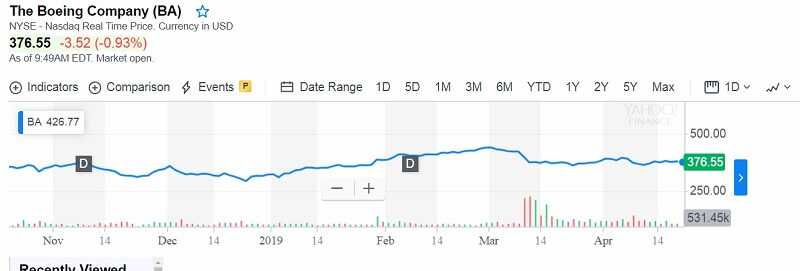
    Image Boeing company chart: source Yahoo Finance

    This company had hard March this year. After the fatal crash of Ethiopian Airlines, its shares fell down.

    The company took the problems with their jet seriously and experts are working on new software.

    On the beginning of the March this year their shares were worth $446, but now they are about $400. The stock could jump when their 737 Max types are on the sky again.

    It is a very steady company. Their F-15 fighters are extremely valued.

    Boeing arranged a selling of those fighters with US Air Force over the next 5 years for $8 billion.

    The company raises the quarterly dividend yield for 2.6%.

    Boeing announced a quarterly dividend of $2.055 per share which is $8.22 per year. This is a 20.2% rise from the previous dividend of $1.71.

    The annual yield on the dividend is 2.6%.

    • Colgate-Palmolive (CL)

    Top Stocks to buy 2019 and Hold Forever 3

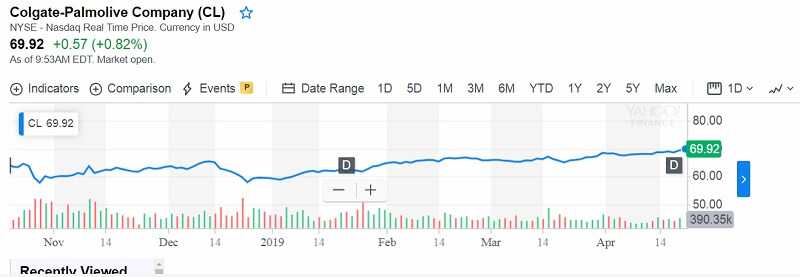
    Image Colgate-Palmolive chart: source Yahoo Finance

    Why do we add Colgate here while everyone knows that this company recorded some suspicious inclinations in spending? Yes, we know that shareholders didn’t like that. That’s is changed as the company decided to make an important decrease in the costs. The advantages of that effort could last decades.

    Their brands are among most buying products. For example, their toothpaste, or soap (of course Palmolive soaps), and manual toothbrush, and other pharmaceutical products for dentists.

    The company is selling its products in more than 200 countries. Colgate-Palmolive includes two product sections:

    ersonal, oral, and home care is one; and the second is pet nutrition.

    It is a leader in the global oral care market.

    Also, it is a leader in pet nutrition products for dogs and cats.

    They’re all made by Colgate-Palmolive Company.

    The company declared a dividend yield on 2.50% and the year-to-date gain of 16%.

    Well, some can say Colgate is high-risk stock but with the big potential returns.

    • Alphabet (GOOGL, GOOG)

    Google

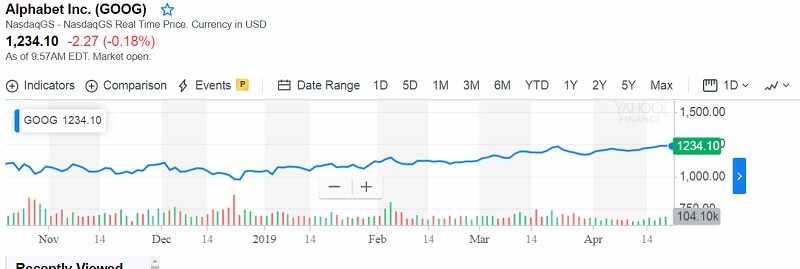
    Image Alphabet Inc. chart: source Yahoo Finance

    Alphabet Inc declared $12.77 per share for the last quartal.

    It looks that Alphabet is the revenue growth provider. Revenue grew 21.5% to $39.28 billion in the fourth quartal.

    It is for sure one of the stocks which you have to buy and hold forever.

    This tech titan is Google parent company.

    Alphabet Class A and C shares have grown 15.5% and 15.4%, over the one-year period April 18. The S&P 500, including dividends, is up 9.4% over the same time frame.

    Yes, the quarter’s reported earnings will be negatively influenced by a 1.5 billion euro (about $1.7 billion) penalty required by the European Commission in March.

    The European Commission claimed that Google demonstrated anticompetitive methods linked to deals it had with Adsense for Search associates.

    Well, the company is prepared to appeal, so investors may be sure that the penalty will be lower.

    Google’s revenue grew quick.

    The cost of sales would increase in the fourth quarter, forced by higher sales and projected content purchase costs at YouTube.

    There are also, Fiber high-speed internet industry, and its Verily life science.

    We all can see the changes because Alphabet’s self-driving vehicle tech branch Waymo recently start being monetized.

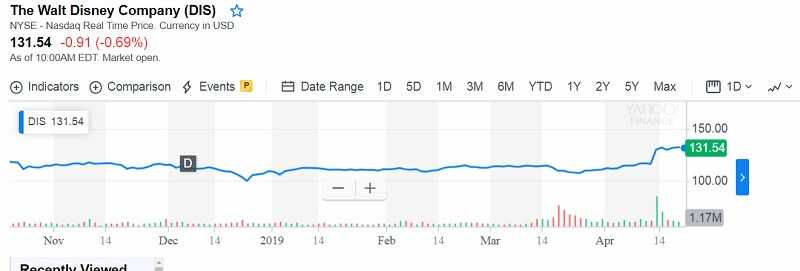
    • The Walt Disney Company (DIS)

    Disney

    Image The Walt Disney Company (DIS) chart: source Yahoo Finance

    Disney is the globe’s greatest media. They have movie studios, television networks.

    Assets controlled by Disney add Disney Animation Studios, Pixar, Marvel, Star Wars, the ABC network, the Disney Channel.

    Disney is close to finalizing an arrangement to take 21st Century Fox. That will combine the 20th Century Fox film studio, National Geographic, and a mixture of other media assets. But not the Fox News.

    Disney has Disney Plus streaming service.

    In the first half of April,  it revealed the price, shows, and movies. Everything planned to overcome Netflix as a rival.

    In 2018, Disney launched ESPN+, their streaming service, and in the time frame of five months had more than a million subscribers.

    And don’t forget, Disney owns Hulu. Disney plans for its three platforms to be separate subscriptions, but it’s likely to connect them at a discount.

    In the moment of writing this article, we are two days out from the release of Avengers: Endgame.

    Predictions about how much money it will bring to Disney are fantastic.

    THR – the range of $200-$250 million.

    Deadline – passing $260 million, and maybe $300 million marks. ComicBook.com – prediction gathered from 3 analytics, $300 million.

    Impressive.

    Disney’s stock has jumped 13.6% in just five trading days in April. They will not look back now. Disney is a market sweetheart.

    Not bad for an old player.

    It is a good investment and one of the top stocks for sure.

    Don’t waste your money!

     risk disclosure



  • HFT Strategies – The Tips and Secrets

    HFT Strategies – The Tips and Secrets

    3 min read

    HFT strategies - the tips and secrets
    HFT uses practically basic and simple strategies. High-frequency trading is not about implementing the strategy, it is all about speed of execution and flexibility.

    Well, the main strategy of HFT is to run faster than others. Of course, the principles of high-frequency trading (HFT) firms are secrecy, strategy, and speed.

    Algo trading is linked with the execution of trade orders. But HFT refers to the implementation of proprietary trading strategies.

    High-frequency trading consists of a variety of AT.

    Yes, both enable traders and investors to speed up the response on market data.

    The society of market participants using HFT is extremely mixed.

    There is a crowd of various organizations with various business forms that use HFT and there are many hybrid models.

    For example, some brokers and exchanges are utilizing HFT systems. So, in the estimation of HFT, it is essential to consider a practical perspective.

    It doesn’t matter if HFT is just an add-on technology to realize trading strategies.

    Liquidity providing is one of the HFT strategies.

    HFT strategies - the tips and secrets 1
    Well, the most frequent HFT strategies are to serve as a liquidity provider.

    How does HTF provide it?

    HFT liquidity providers have two primary reservoirs: when they provide markets with the liquidity they pocket the spread between the bid and ask limits. Also, there is a trading income by granting discounts or lowered transaction fees. The aim is to increase market quality and attractiveness.

    HFT firms will never discover their ways of acting. The significant experts linked with HFT are undercover. Well, this is not quite true. Maybe we could say they want to be in front of the public eyes less than others.

    Those firms operate with various strategies to trade and earn money. The strategies are often many kinds of arbitrage. For example, volatility arbitrage, or index arbitrage.

    HFT employs software that is incredibly fast. They have access to all market data and can make connections with minimum latency.

    HFT firms regularly use own money, own technology and a number of special strategies to produce profits.
    There are numerous strategies applied by traders to earn money for their firms.

    Even the controversial strategies.

    For example, HFT firms may trade from both parties.

    Hence, they can place orders to sell using a limit order above the market price. Also, they can place the buy order a little bit below the market price.

    And, voila! There is a profit for them. The difference between the two prices. They are market makers. All these transactions are very fast, in a millisecond by using algorithms and robust computers.

    Spread capturing as HFT strategy

    HFT strategies - the tips and secrets 2
    HFT firms are liquidity providers. They profit from the spread between the bid and ask prices.

    How?

    They are buying and selling securities all the time.

    With each trade, they receive the spread between the price at which shareholders buy contracts and the other at which they can sell contracts.

    Rebate driven strategies

    The liquidity provision strategies are developed on particular stimulus systems.

    In order to encourage liquidity providers, some trading venues use unsymmetric pricing. They charge a lower fee or give a rebate for market makers or passive trading.

    Why?

    Such traders bring liquidity to the market.

    On the other side, for more aggressive tradings they charge a higher fee. Why? Such traders remove liquidity from the market.

    An unsymmetric fee arrangement aims to boost liquidity provision.

    Point is: traders supplying liquidity earn their profits from the market spread. Fee discounts or rebates stimulate a market‘s liquidity.  

    On this way, those markets look promising comparing to their rivals.

    Arbitrage

    Chances to perform arbitrage strategies generally survive only for fractions of a second.

    But computers mission is to examine the markets in a millisecond. That feature causes the arbitrage to become the main strategy employed by HFTs.

    To conduct arbitrage HFT use the same method as traditional traders. But they use an algorithm to profit from short-lived differences between securities. The other types of arbitrage are not restricted to HFT and such, they are not the subject of this post.

    Latency arbitrage

    The latency arbitrage is the ability of HFTs to recognize new market information before other market participants even get it.

    The latency arbitrage uses direct data feeds and co-located servers to short the reaction time. Latency arbitrageurs profit from speed power. Such market participants can reduce the prices at which other traders are able to trade. That’s why you can find them under the name of predatory.

    Liquidity detection

    HFTs try to recognize the patterns other traders leave and adjust their actions accord to them. The focus of liquidity detectors is large orders.

    Liquidity detectors are getting information about algorithmic traders is usually called sniffing out the other algos.

    The bottom line

    HFT is not a trading strategy. It is the usage of advanced technology that performs traditional trading strategies. The individual trading strategies need to be assessed rather than HFT as such.

    HFT should never be banned. It would be contrary to market efficiency. High-frequency trading contributes to market liquidity and to the ability of the price creation.

    However, any strategies that have a contradictory influence on market integrity or enable market abuse, has to be are completely reviewed.

    This is particularly important for HFT. If anyone believes this technology promotes the implementation of abusing strategies, moreover, makes them more profitable and creates unfair circumstances on the market, should check the other participants too.

    Our confidence in technology is huge, but we are very cautious when it comes to the people.  

    Technology by itself is without morality. The people are those who can add it to high-tech.   

    Fortunately, we, ordinary people, don’t have any access to HFT.

    Don’t waste your money!

    risk disclosure
  • Where to Invest – Know How to Find

    Where to Invest – Know How to Find

    3 min read

    Where to Invest - Know How to Findby Gorica Gligorijevic

    OK, you think it is time to start investing! But before you dive into that world you have to know several things. Very important things.

    This article is not about where or how to invest. It is all about how to find what is necessary to do before you decide to invest and where to invest.

    We need to know more about how should we invest our money.

    Most of the time we do so without any research. That is completely wrong!

    Who even try to find some information about investing was overwhelmed by the tens of thousands of stocks, bonds, mutual funds, etc out there.

    You must be so scared of all the options. And you may give up.

    But keeping all your money in a savings account can take you on the wrong side.

    Nobody starts out as a specialist. Even the best investors were in your shoes.

    For the start, you must consider two questions.

    The first one is, where should you begin.

    And second, how to begin.

    First comes first.

    Where to begin.

    You may read different financial websites.

    As a financial site, Traders Paradise,  research all the time, collecting information from different sources. We have our tops, it is so natural.

    But we would like to share with you some free websites.

    The best-of-the-best that can provide you the education and news.

    We can tell you to read us, but you already do that, indeed.

    The best information about where to start investing we found on Cabot Wealth Network that includes a lot of free information. Their education section has valuable data about Stock Market Analysis, Market Timing, Selling Stocks, Technical Analysis and plenty of others.

    The site Investopedia is a very good source too.

    It is an invaluable source for definitions of financial terms. This site has tutorials and articles broken down for beginners. And all is free. Investopedia is a great site even for professional traders.

    Don’t give up when you see their long long sentences, they are hiding very valuable data inside.

    Among free websites, Traders Paradise highly recommends the Motley Fool. Don’t be foolish! Their name is just a good cover. These fellows are all market.

    They are excellent no matter if you are seeking to make your own analysis, or like the help of an experienced specialist. The Motley Fool is ready for you.

    Yes, you have to pay some of their services, but that could be a genuine opportunity for you, a beginner.
    Traders Paradise wants to recommend one site more. It is AAII Investor Classroom: www.aaii.com/classroom. But it isn’t free.

    It bears many lessons. They are treating everything from the risk management to the dividend stocks evaluation. The cost to join is $29 per year.

    If you want to start investing, you should analyze the characteristics of a company in order to evaluate its value.

    Where to Invest - Know How to Find 1
    That is security analysis. You have to check a company’s financial documents and financial circumstance, its management, and rival advantage. Of course, you would like to identify its rivals and markets.
    Why is this important?

    The technical analysis finds that all the major parts of a business are reflected in the price of the stock. Technical analysis examines the market supply and demand.  It is an effort to recognize where a stock’s price will go in the future.

    Amongst sites needing paid subscriptions, we recommend Investor’s Business Daily eTables, Zacks, and

    American Association of Individual Investors (AAII). They are really helpful.

    For example, Zack’s does expect membership. If you want to get to the spicy material.

    Well, surprise, surprise!

    The membership is free. You can devote three minutes to sign up. You will have an in-depth review of both stocks and funds. Moreover, you will have access to many free reports that will help you.

    And you have to read books.

    Where to Invest - Know How to Find 2
    There are thousands of various books about investing. One of them is everlasting and evergreen “The Intelligent Investor” by Benjamin Graham.  

    You can find a lot of respective books out there. You can adopt the main ideas from these books because they touch any market over the globe. Well you know,  many questions are the same to all worldwide investment. The macroeconomic indicators, asset allocations, and currency risks are the same all over the world.

    Investors are overwhelmed with information. Everything is trying to catch your attention. From press releases to SEC filings, for example. Yes, it’s always helpful to be informed.  But how to isolate the good information from the uproar.

    Press releases usually neglect bad information. They are adjusted on the good news. Analysts have spectacularly prejudices. At the same time, the official statements are tricky to be used, actually, they are not useful because of their vocabulary.

    So, where to look for information before you start investing?

    Corporate websites include information about a company. From financial statements to annual reports and surveys.

    When you are seeking the financial information they can be easier to navigate.

    What you have to look for?

    First of all, financial statements.

    Of course, you would like to take a look company’s presentation. Remember, never neglect this.
    Company presentations can give you an important summary of the past result. Also, the predictions for the following years.

    Company press releases can hold a treasure of information about progress and financial fulfillment.
    Find their investor contacts. They can be an important source for investors. But always keep in your mind who is paying them.

    Securities analysts can be an excellent reservoir of information for investors. Buy-side analysts are a better reservoir because they are not so biased. Analyst reports can be found in places including:

    You can find analysts reports among stockbrokers.

    Also, among companies.

    Some companies offer analyst research to potential investors.

    Find some broker with the fiduciary obligation.

    A fiduciary relationship is where one person (fiduciary) undertakes to act for another, placing his or her interests ahead of their own.

    We will give you a quote from the legislative site:

    “Fiduciary obligations refer to the duty to avoid conflict, the duty to not make a profit, and the duty not to gain a personal benefit or a benefit for a third party, without the consent of the principal.”

    But most of the necessary things you have to do by yourself.

    You have to examine your needs and goals.

    It’s worth to think about what you actually desire from your investments. Take your time. If you know your goals, your risk tolerance, you are on a good path.

    Estimate how long you can invest.

    Consider about how quickly you need to get your money back.

    Or just let a robo-advisor invest your money for you.

    Don’t waste your money!
    risk disclosure


  • Trading Forex at the Weekend Gaps

    Trading Forex at the Weekend Gaps

    3 min read

    Trading Forex at the weekend gaps is a growing field of investment. Forex weekend trading hours have extended away the traditional trading week.

    Forex trading the weekend gaps are becoming popular because of trader’s expecting Sunday’s opening price to return to Friday’s closing price.

    There is a mistake that you can’t trade over the weekends.

    So,  you surely can trade online at the weekend. To be honest, weekend trading in currency, stocks, CFDs, and futures is increasing fast.

    Actually, the forex market is opened during the weekend.

    How Trading Forex at the weekend gaps is possible if we know that the forex market is working 24/5?

    Well, it is decentralized. And technically the forex market is open 24/7. It is true that the majority of dealers close transactions on the weekend. For retail traders close at around 5 p.m. EST on Friday and open around 5 p.m. EST on Sunday.

    And we can see a gap during the forex open time only when the price movement is great because of some news.

    But gaps are quite obvious in the forex market when the market is closed over weekends.

    How does it come?

    The market prices are moving over the weekend. You can not stop the currency transaction. For retail traders, the price isn’t the same on Friday when the market closes trades and on a Sunday afternoon when it opens.  

    If the price is higher on Sunday, we have a gap up. But we will have a gap down if it opens lower than the Friday afternoon price.

    Trading Forex at the weekend gaps is very familiar to forex traders. It is a very often use strategy. Why is that?

    Well, the Forex market is, in fact, open 24/7. Yes, trading ends on Friday and can be opened on Sunday evening.

    But so many things can influence the currency price movement over the weekend. So, when traders are trading at weekend gaps, they are expecting the opening price will hit the closing price.

    The gap traders believe that the price will continually fulfill the gap. Really? In fact, it constantly does. But it isn’t feasible always.

    That’s why some traders make losses. Some gaps are tradable some are not.

    For example, we recognize four varieties of gaps.

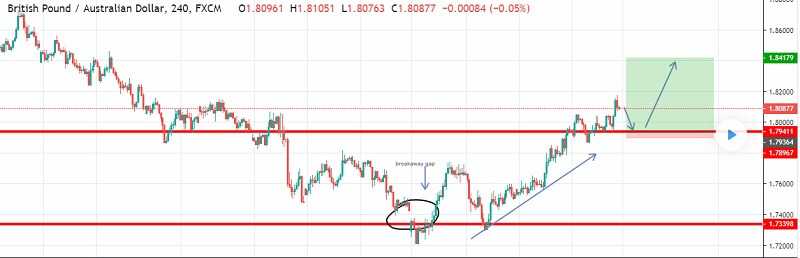
    Breakaway gap

    The breakaway gap regularly rises a new trend.

    The price frequently develops out of the consolidation phase. Moves up or down with powerful momentum. What leave behind is the gap.  

    Some crucial, breaking events may cause movement. That new trend isn’t always tradable. Breakaway gaps happen at the end of the price pattern. They indicate that the new trend is starting.

    Trading Forex at the Weekend GapsThe breakaway gap

    Exhaustion gap

    Exhaustion gap occurs close to the end of a price pattern. It indicates a definitive try to reach new highs or lows. Usually, it comes after a sudden move. It has an unnatural rise in volume and then turns strongly. Also, you have to know that it comes after some news or reports. For example, after the earnings announcement. That is the period when trading activity increase. Traders are closing their big positions. That causes an obvious reversal. You can find the exhaustion gaps no matter if it is an up or down trend.

    Trading Forex at the Weekend Gaps 1The exhaustion gap

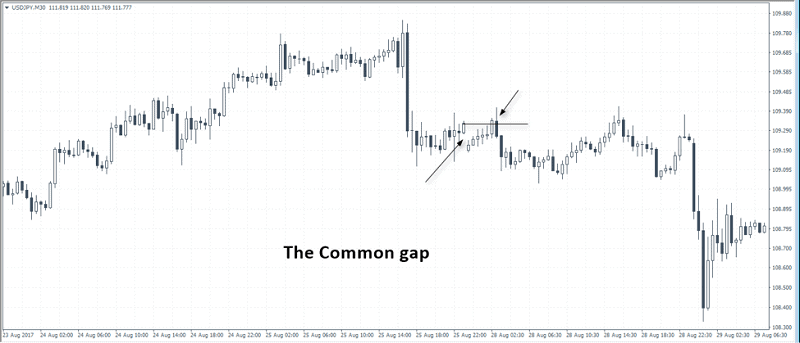
    Common gap

    It simply represents a space where the price shows a gap.

    They are gaps seen on a price chart and they are very common and the most generally traded.

    Also, they regularly arrive late Sunday and early Monday market openings.

    They are suitable for short-term intra-day trading. You should look for a common gap around Sunday midnight and trade those Forex gaps at that time.

    Trading Forex at the Weekend Gaps 2The Common gap

    Runaway gap

    Runaway gaps mark trend continuing. A runaway gap is fairly one of the most secure ways to trade. Particularly if you combine them with other price tools.  

    A runaway gap happens when the price is gapping into the course of the trend. When the trend is strong you may see them.
    Runaway gaps regularly work inside a trend.

    Traders need to recognize the gap before they find the potential increase in price. This means that runaway gaps are traded after the action.

    The bottom line

    The gaps can give a lot of news about market moving.

    Trading at the weekend gaps is risky.

    But you can use the information produced by a price gap to develop a complex trading plan. It can be helpful with other trading ideas.

     risk disclosure

  • High-frequency Trading Algorithms Characteristics

    High-frequency Trading Algorithms Characteristics

    High-frequency Trading Algorithms CharacteristicsHigh-frequency trading algorithms or algos are rigidly secured by their owners.

    By Guy Avtalyon

    High-frequency trading algorithms can be amazingly easy to use. And beneficial too. Where is the catch?

    By their nature, because they are so fast, those algos know the future price, they don’t even have an attempt to predict them. The slower shareholders need to predict prices, algos don’t.  High-frequency trading algorithms use arbitrage, traditional technical analysis, and everything that works. Their purpose is to implement and modify well-known strategies while running with their extraordinary speedy setup.

    The High-frequency trading algorithms main advantage is getting price quotes earlier and placing orders faster than the bulk of other traders.

    Of course, the profit may depend on the software’s latency. Or it can be some lag between the price quote and following order execution. Latency is the most important part of an HFT algorithm.

    High-frequency traders can optimize latency in two ways: if you minimize the time to reach the exchange or if you maximize the speed of your trading system.

    Traders use algorithms for trading to reach higher performance to markets.

    Algorithmic trading is like traditional trading.

    You want to buy or sell the security. The whole process is based on the predefined collection of rules examined on past data.

    That means every HFT algorithm use indicators, charts, technical analysis, etc.

    HFT firms decrease latency by fastening direct market access.

    As an HFT trader, you can get data from the market nonstop, and without third-party. The direct market access gives you the capability to enter market orders straight into the market’s order book. This is an important feature of a low latency trading platform.

    That guarantees that you will receive data before then other traders that are not using direct market access. So, you will be able to participate in the marketplace before the competitors.

    HFT methods gain an advantage via ultra-low latency

    It is possible through the establishment of two important inputs:

    Automated trading algorithms

    It is known as “black box” trading systems. Actually, it employs multiple algorithms based on various market variables. It provides a trader to get trading signals and identify a possible trading chance. That signal is traded automatically by installed trading software.

    Collocated servers

    These servers are given to the trader and connected to the market or exchange. They are actually placed at the exchange or market. The advantage of collocated servers is that they give you direct market access with hugely decreased latency. That’s why they are better than remote servers.

    The main task of a good HFT algorithm is to reduce the time of traders’ access to the market.

    The use of the HF trading algorithm altogether with collocated servers guarantees an exact and up-to-date synergy with the market.  Complex algorithms identify and execute trades build on strategies. These strategies are known as order anticipation, arbitrage opportunities, momentum.

    So, is it possible to compete with algorithmic trading?

    Well, we have to say it isn’t. Don’t try to beat a High-Frequency trader! You will lose that match. The HFT has plentiful supplies and is be able to keep the algo running 24/7. Can you keep alert all that time? Can you be functional and reliably?

    HFT includes multiple sub-disciplines.

    They are quantitative techniques with short time holdings.

    It is established on technical and fundamental analysis. Yes, they use traditional patterns to make trades. They are a very fast variant of what traders have done for a long time before. Also, HFT includes algorithms to prognosticate hudge buying or selling patterns. They use high-speed connections and co-located servers or in-house exchanges. And in a millisecond places trades based on those forecasts. They know what the next will happen!

    The simplest algorithm is based on technological and geographic recognition.

    Remember, the length of the optical connections is very important. The HFT algorithms can evaluate the order attributes, and discover if it is an indicator that related orders will go to other markets.

    And what will happen? The High-frequency trading algorithms will place the order to buy at the offer price at the other exchanges. 

    High-frequency trading algorithms will always take advantage of the speed of execution.

    HFT knows how to force the price to a higher level. It will buy all the stocks first and push the price to grow. And?

    So, if some trader places the order with the limit order on that or higher price the algo will be the winner. It will use the spread.
    Because of its dominance in the rapidity of execution.on technical and fundamental analysis. Yes, they use traditional patterns to make trades. They are a very fast variant of what traders have done for a long time before. Also, HFT includes algorithms to prognosticate hudge buying or selling patterns. They use high-speed connections and co-located servers or in-house exchanges. And in a millisecond places trades based on those forecasts. They know what the next will happen!

    The simplest algorithm is based on technological and geographic recognition.

    Remember, the length of the optical connections is very important. The HFT algorithms can evaluate the order attributes, and discover if it is an indicator that related orders will go to other markets.

    And what will happen? The High-frequency trading algorithms will place the order to buy at the offer price at the other exchanges.

    HFT algorithm will always take advantage of the speed of execution.

    HFT knows how to force the price to a higher level. It will buy all the stocks first and push the price to grow. And?

    So, if some trader places the order with the limit order on that or higher price the algo will be the winner. It will use the spread.
    Because of its dominance in the rapidity of execution.

  • Order Flow Trading

    Order Flow Trading

    3 min read

    Order Flow TradingOrder flow or transaction flow

    Order flow trading is more of a mindset. We cannot say it is a trading system or trading method. It is all about how some traders are viewing and imagining the market place.

    Say in this way, the orders are moving price.

    So, the intent of an order flow trader is to identify patterns on which they are getting triggered.

    It is also called a transaction flow. 

    Order flow happens when a trader believes the price of an asset will move and then the trader chooses to execute the order.

    Also, order flow trading is an expression that generates a lot of mess.

    Some traders believe that such trade is based on very secret information from the banks. That just a small group of people have knowledge about it.

    But you can see that some of them believe that it is another kind of price performance.

    To determine order flow trading you have to clarify what kind of trading you want to execute.

    Many of the retail forex traders are trying to place directional bets.

    That is when the trader is going long or short, speculating that prices will go up or falling.

    For example,  if a trader believes a currency pair will move up, he/she will set a buy order. But if such a trader prediction is a currency pair will go down, he/she will go short, meaning the trader will sell. This is directional trading.

    It is one of the most traditional styles of trading.

    If you choose directional trading, you may decide to be a dynamic trader. You want, for example, to execute a market order and pay the spread. That is one possible choice.

    The other alternative is to set a limit order or stop order marking the order flow to be executed at a specific price or executed after the market hits a specific price.

    This is different sorts of order flow.

    Order Flow Trading 1Order flow trading is alike to price action trading

    The trader who executes a market order is achieving a more dynamic order. Such doesn’t like to wait for a limit order.

    It is questionable if that order will or will not be filled.

    But the trader who set a limit order or stop-loss order is creating a more inactive kind of order flow. Even if the orders are not executed, they are helpful in building the order flow.

    Order flow trading is alike to price action trading.

    They both intend analyzing the market in a specific style.

    Price action traders try to conclude which direction the market going to move in. Order flow traders think they can foretell the same thing but based on capturing the actions the other traders done in the market.

    Order flow trading, so how does it work?

    The basic idea lays behind that if you are able to recognize when and where traders are going to make decisions, you can presume what is the future course of the market. The main purpose is to determine when the prices are moving up or down.

    To be more clear, one trade will never cause such movement.

    But thousands of orders appearing at the same time can generate the price’s turn.

    And we can say that the main intent of order flow traders is to find how other traders trade. On that way, such a trader can recognize when numerous orders will appear to the market, large enough to generate a price movement, either up or down.
    All the trader needs to know is what is the basic goal of their trading method. Based on that knowledge, he/she can predict on which position they will make a decision which will place orders into the market.

    The basics of order flow trading

    Order Flow Trading 2Two types of order flow trading

    There are two main types of orders that traders can execute in the market.

    Each of them is executed for different reasons. Hence, have different influences on the market price after execution.

    The traders can place market orders or limit orders.

    One group will place a market order because they want to earn money as quickly as it is possible.

    They place a market order to open their trade because they don’t want to miss such a great chance. This is so-called reactive strategies. Meaning, the traders are reacting on what is happening in the market at this moment.

    When a trader places a limit order, that means that trader wants to have a trade at a price which he expects will be reached in the market.

    Stop losses are also limit orders because they provide trader to buy or sell at a price which has to be reached in the future.  
    Both affect the market price but in different ways.

    A market order spends some of the liquidity in the market. On the other side, the limit order is placed to add liquidity to the market.

    And, here we are!

    The keyword for order flow trading is liquidity.

    Liquidity explains how accessible is it to buy or sell in the market.

    When it is easy to sell or buy, the market is liquid.

    For example, the forex market is one of the most liquid financial markets in the world.

    Buying or selling on the forex market is so easy because you will always find who is going to sell to you or to buy from you.
    Why is this so important for order flow trading?

    When low liquidity occurs that means that most of the orders on the market are buy orders. The traders can’t achieve buy trades placed because there are not enough people in the market ready to sell.

    There have to be a big amount of sell orders placing the market in order for the market to be liquid.

    It is really important to learn that when low liquidity is approaching the end, it means the traders have made the decision in the market.

    But which decision?

    That depends on which course the low liquidity movement happened. If it was a drop-down then the traders have placed buy trades or carried profits off sell trades which have previously been placed.

    If it was an up-move, traders placed sell trades or took profits off buy trades.

    Price does not move because of some mysterious technical indicator. Nor moving average will move the price.

    For the price to move, traders need to execute enough orders to utilize the liquidity at the best bid/offer.

    If there are no orders to be executed, the price will not move.

    This is the cruel truth in trading.

    The market will never move to your direction if there is no order flow.

    The outcome of the trade is managed by the performance of other traders. The real transaction and order flow are produced by other traders.

    The bottom line

    Order flow trading is not a technical analysis or fundamental analysis. They are not able to move the market.

    Order flow and liquidity is the base of the market.

    That’s why many traders have gained the losing tradings. Their losses happen because the technical or fundamental analysis cannot produce enough order flow to move price in your favor.  

    Order flow trading tries to improve the lacks in technical and fundamental analysis.

    When you learn and practice enough, you will find this is the most successful approach to trade.

    Don’t waste your money!

    risk disclosure
  • Forex Trading in the Indian Market is Not Fully Legal

    Forex Trading in the Indian Market is Not Fully Legal

    Forex Trading in the Indian market is Not Fully LegalIndian Forex market is not fully legal

    By Guy Avtalyon

    Forex trading in the Indian market is legal. RBI puts a lot of restrictions on trading, but still, there are possibilities for Indian residents to participate in the Forex market.

    So, we can say, it is allowed to trade Forex inside Indian Exchanges. All resident Indian or companies, banks, and other financial organizations can trade in the currency market.

    But Foreign Institutional Investors and Non-Resident Indians are not allowed to trade in the currency market. So, once again if you are resident Indian, you can trade currency over Indian exchanges like NSE, BSE, or MCX-SX. The main currency pairs are USDINR, EURINR, GBPINR, and JPYINR.

    The point is that you can trade with respect to those two conditions: being resident Indian and the broker you choose is in the club of the exchanges mentioned above.

    In those cases, Forex trading in India is unquestionably legal.

    Forex trading in India is legal and safe.

    There is remarkably strong regulation established by the RBI concerning Forex trading.

    The problem is that RBIs regulation allows you to trade only 4 currency pairs, USD/INR, EUR/INR, GBP/INR, and JPY/INR.
    But, it is possible to trade.

    Yes, you cannot open an account out of the country, you have to trade with registered Indian brokers and listed currency pairs.
    So, take this suggestion! If you are resident Indian and want to neglect the laws, you can also open an account using offshore exchanges. But you are doing that at your own risk.

    Converting the INR to other currencies for the purpose of trading the FX markets with abroad Forex brokers is an illegitimate project. Such action in India is strictly against the law and can bring draconian penalties and also the prison.

    How to do a Forex trading as an Indian trader

    This is where things are a bit tricky. If you live in the rest of the globe, trading forex is the normal and regular thing.

    For example, if you are a resident of some EU country or you live in the US, you can trade any currency pair in the world. You can trade even over unregulated brokers, at your risk of course. But when you trade on Forex market that is pretty unregulated you are trading at your risk anyway.

    When it occurs in India, it is quite complex.

    Is Forex trading fully legal in India

    The problem is that trading currencies in Forex trading in the Indian market is not fully legal.

    You have only one possibility, and it is the same for the resident Indian, you can trade only the currency pairs that have INR (Indian Rupee). And you may choose among 4 currency pairs USD/INR, EUR/INR, GBP/INR, and JPY/INR.

    What is the story behind this? We assume one possible scenario. The US dollar is the most popular and the most traded currency.

    And INRs value in comparison with the US dollar is too low. So, if many traders would like to buy dollars, the Central Bank of India could be short. The next what the Central Bank of India could do is to buy dollars. But the price would not be the same. It could be much much higher. It is possible at worse rates and INR will continue going down.

    That sounds logical.

    In the same way, online trading and using online platforms are not allowed for Indian citizens. Foreign brokers can offer their services in Forex trading in the Indian market. Though, Indian traders can trade only with brokers certified by SEBI. And again, they can trade only currency pairs denominated in INR.

    This the moment when we have to say that it would be smart to reconsider those limits. In such a case, Indian Forex traders could enjoy full currency trading.

    As we heard and read several times, the Indian government is contemplating eliminating the restrictions in order to provide the other popular pairs to be traded. That will be nice.

    Until then, if you want to trade with abroad brokers, you should be sure that they have the required licenses.

    Our recommendation is to choose the approved Forex broker that has an extraordinary credit. It isn’t hard to find some, for example, TradeO.

    Trading Platforms for Forex trading in the Indian market

    For Indian traders, it is impossible to use online Forex platforms or software. Simply, it is illegal.  

    But still, not all Indian traders are citizens of India, so they can use them.

    For those who can trade online from India, there are few things to consider.

    Choose the broker with a user-friendly interface.

    Also, it has to easy to manipulate.

    The button that can close all of your positions when you want that has to be included and visible.

    Further, your broker must offer you several platforms. One, for example, Metatrader 4 or Metatrader 5, that you can download and at least one to trade from your browser.

    The most convenient is if you choose the broker that provides you to download the app. You can easily install it on your phone.

    So, you don’t have to be stick to one place when you want to trade.  

    When it comes to account types, the majority of brokers will allow you to open the account with a small deposit. It can be, for example,  $50-$100.

    But maybe you want to trade with a much bigger amount of money. Anyway, you should contact your chosen broker and discuss the rules, and find out which type of account suits you best.

    Also, you should check if your broker has a free demo account. Either you are an advanced or beginner trader. Trading on a free demo account will give you the view of how the platform works, or you can learn more before you give them your money.
    Happy trading, India!

  • Currency Trading Guide For Beginners

    Currency Trading Guide For Beginners

    3 min read

    Two Different Approaches to Profitable Forex Trading 3
    Currency trading, also foreign exchange or Forex trading, is the buying and selling of currencies. That is happening in foreign exchanges or in the foreign marketplace. The main goal is to make a profit.

    Often you can find it is called ‘speculative Forex trading.’

    The main difference between currency trading and other trading is the liquidity of the Forex market.

    When you participate in the forex market, in essence, you have to buy one currency and sell for another at the same time.
    This is called a currency pair.

    Each one is interpreted by three letters. The first two letters describe the name of the country. So, the third letter interprets the name of the currency.

    How can you make a currency trade?

    Base currencyCurrency trading: Currency pair

    Currency trading is regularly executed completely over brokers and market makers.

    If you want to trade in the Forex market you will depend on the brokers in order to execute a trade.

    The first thing you have to do is to pick a currency pair.

    If you make a mistake, it could lead to a losing trade.

    So, we recommend you to choose between seven major currencies. Honestly, you have to pick one of existing seven. It isn’t a big deal!

    But there some problem may arise.

    There are some traders who have difficulties pairing up currencies. Sorry, but we have to say that.

    Some others cannot recognize which pair will perform the best.

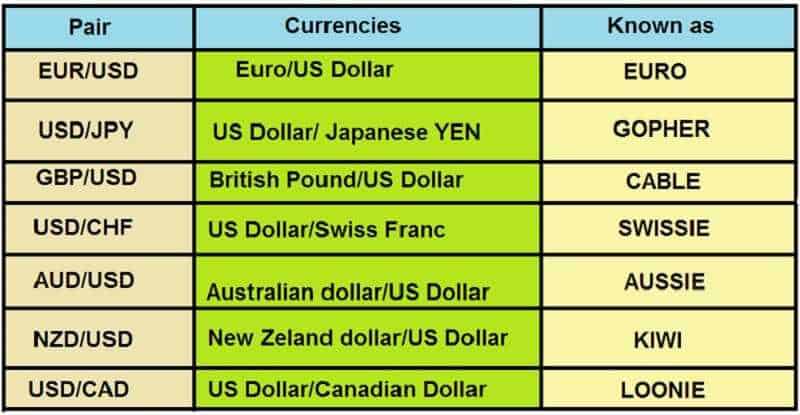
    As we said, there are 7 major currencies. And, they are most traded.

    You have no other choice than to trade them in pairs.

    Forex trading is profitable - Is it the truth?Currency trading: 7 major currencies

    The first mistake you may make is to pick your pair based on some country’s economy. Don’t do that because your profit will depend on your position while trading on particular currency pair.

    That means if you are willing to be a day trader or very active trader you will probably pick 4 or even all 7 pairs.

    On the other hand, if you prefer to be a long-term trader you would like to wait and see which pair perform the best. Such traders always want to catch the best opportunity and they rather wait than to hurry.

    Say, you are a conservative trader.

    What you have to know?

    Number one, the forex market is open for currency pairs’ trading 24 hours a day. From 6 PM on Sunday in New York, to 4 PM on Friday.

    Each day starts at the Sydney market open. It is 5 PM to 2 AM Eastern Standard Time. Then switches into the Asian market. Tokyo’s market is opened from 7 PM to 4 AM.

    That’s not the end. When the Asian market is near to be closed, the European markets are starting their session. It starts with London’s market opening from 3 am to the midday.

    The last session belongs to New York. It begins at 8 am to 5 pm.

    That represents one week of forex trading session.

    So, you can place your trade when and where you want. The Forex markets are opened 24/7.

    What you have to take care of when trade currencies?

    Following Lead Traders - Good Or Bad For You?Currency trading: make a profit

    Well, the first is its value. Currency price is changing fast and frequently. The reasons for that can be various. For example, Brexit is one of them. But sometimes, the market by its own nature will cause changes in currency prices.

    The fluctuation isn’t a bad thing, but when it comes with high frequency, you might not be able to determine the changes which could cause the loss.

    For example, the euro is strong. And countries from the EU would buy, let’s see, U.S. products. In order to meet payments, they have to change euros for US dollars.

    So, we have the following situation.

    If large amounts of euros are traded for U.S. dollars in a short time frame, it forces interest for the U.S. dollars. As a consequence, the U.S. dollars value increases. On the other side, the value of the euro related to the U.S. dollars decreases.

    The risk involved in currency trading

    Currency trading implies high leverage.

    It is very possible with small investments to gain a big amount of cash.

    Forex is not highly regulated. There are several sorts of trades not regulated at all. That can boost the risk of currency trading.
    If you are the beginner in currency trading you should start on some free demo platform. There is no risk involved.

    If you have a certain good result, and only IF, you should start with live currency trading.

    Don’t waste your money!

    risk disclosure
  • Indian stock market is worthy to invest

    Indian stock market is worthy to invest

    Indian stock market is worthy to investIndia: Taj Mahal
    By Guy Avtalyon

    Are you one of the rare investors who know what magnificent opportunities you can find in investing in the Indian stock market?

    Or you are not?

    It is a promising market. But, before investing in the Indian stock market, here’s what you should know. It is essential to focus on the stock market if you want to invest in it.  

    First of all, you should know that India is globally the quickest expanding economy.  Measuring GDP, India takes seventh place in the world. Also, the third-largest buying power parity in the world. The growth is coming from the service industry. After the economic liberalization policies 1990s, Indians considerably improved life.

    Investing is a confirmed way to produce long-term wealth. And besides, anyone can start investing.

    Is the Indian stock market worthy to invest in?

    In India, you have two stock markets where you can make your trades, the Bombay Stock Exchange (BSE) and the National Stock Exchange (NSE). You have to find the company has good nitty-gritty, an basically a strong company.

    The BSE has more than 5,000 listed companies and NSE has about 1,600. Both stock markets match the same trading principles, trading hours, settlement rules.

    Determining a sustainable company is easier said, than done. Anyway, we will give you short reviews of a few Indian companies with big economic moats around them.

    What is MOAT?

    Let’s go back to the past for a moment.

    In the Middle Age, all around the castles were digging channels. Then, they would charge the channels with soil and water. That is the moat. And it was very helpful if the enemy tried to provoke or attack. Thanks to moats the castles were prepared to persist for a long time period.

    The same idea of ‘MOAT’ is appropriate in the stocks.

    Many companies have an unseen shield around themselves. That gives them an influence on the market. They have a brand. For example, Gillette or Colgate or Suzuki or Coca Cola. MOAT companies in India are, for example, Asian Paints or HDFC Bank. Also, MOAT companies may have a business monopoly. Such a case is with Coal India.

    Indian Companies with big MOAT

    • ITC: Cigarettes – ITC Ltd covers 81 % of the cigarettes selling in India
    • Castrol India: Giant among automotive and industrial lubricants in India. Holds around 48% market share in the global Indian lubricant market.
    • Asian Paints: It owns over 54% of the market share in the Indian paint industry.
    • Jockey India: Actually, it is Page Industries, one of the biggest producers of underwear in India.
    • Hindustan Unilever or HUL: Hindustan Unilever or HUL: They offer some of the popular brands, that are used by 2 billion people on a daily base. That, among others, include Cif, Dove, Lipton, Vaseline, Pepsodent, Wheel, etc.
    • Pidilite Industries: It is adhesives producing company. Their brands are Fevicol, Fevikwik, Fevistick, M-Seal, etc.
    • Britannia Industries: It is an Indian food corporation with Britannia and Tiger brands. Its headquarters in Kolkata, West Bengal. Among their offered brand names are biscuits VitaMarieGold, Tiger, Nutrichoice Junior, Treat, Pure Magic, Milk Bikis, Good Morning, Bourbon, Nice, Little Hearts between others. Nestle: It is a famous producer of “Maggi”, chocolates, etc
    • United Spirits or USL: is an Indian alcoholic beverage company and the world’s second-largest spirits company by volume. USL exports its products to over 37 countries. It has more than 140 liquor brands such as McDowell’s, Royal Challenge, Antiquity, Vladivar, Romanov, etc.

    IT and business services outsourcing is a very important part of India’s economy.

    Indians are very well educated, skilled and English-speaking. Moreover, they are not expensive workers. That’s why the IT sector provided about 8% of the country’s GDP.

    Business services outsourcing is a less important but more popular business in India. BPO is the express increasing part of the industry in India. So, it is valuable to consider investing in those companies.

    How to invest in the Indian stock market if you are not its resident

    If you are not an Indian resident the Indian stock market is a foreign market for you. But you can still invest. For example, you can buy stocks directly. Honestly, it is a bit tricky. Much more than investing in domestic stocks. But if you want to invest in some company listed on a foreign exchange you can do it over your brokerage.

    If your brokerage provides that kind of service, it has to contact the market maker in India.   Sincerely, you have to be prepared that the stocks you want are not accessible. That is the bad side. The simplest way is to set up an account directly in some of India’s brokerage. Almost all the notable companies in India are listed on both the markets.

    Even if you are investing in the long-term, always look for a ‘moat’ in the company. It improves the profitability of the company. And it is very important in India’s markets. Having a business ‘moat’ gives these companies plenty of support.